


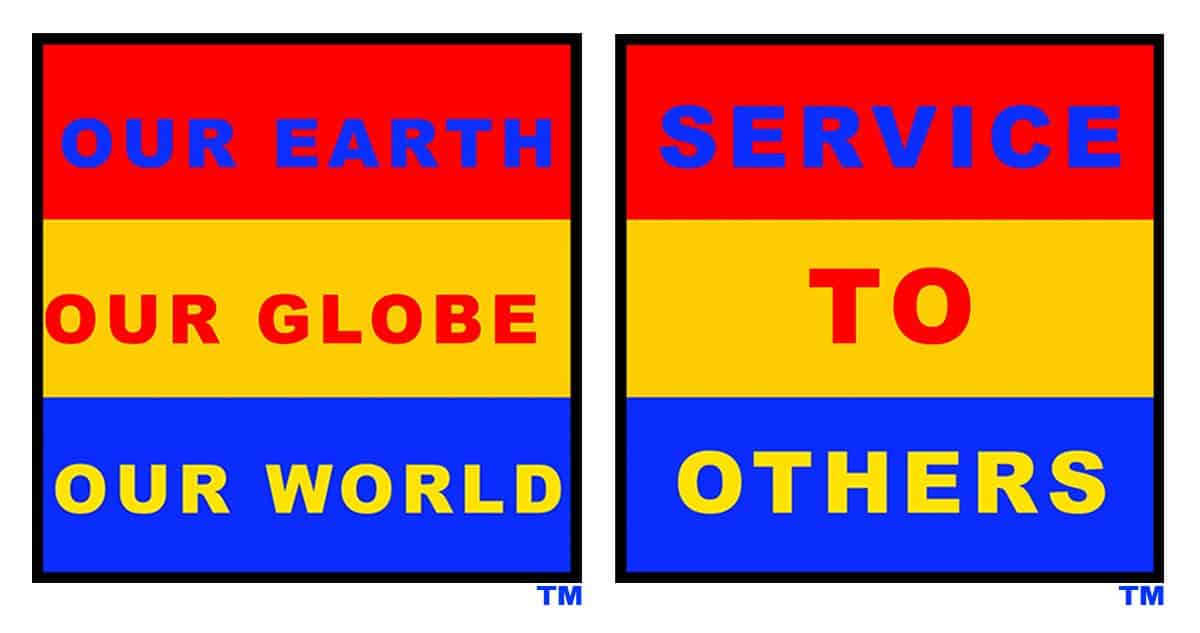
Reimagining the Global Economy Through Creativity, Connection, and Service to Others
By Marty Treinen — Co-Founder, Creative Core International
On a winter evening in California’s Coachella Valley, the sun melts into lavender light and the mountains hold their breath. The air feels older than time — like memory itself.
Out here, under the same sky that once guided ancient peoples, a different kind of economy is being born — not in banks or boardrooms, but in classrooms, studios, and small moments of shared imagination.
It’s called the Service-to-Others Economy — or STOE — and if it sounds idealistic, it is.
But it’s also ancient.
It may, in fact, be the original economy — the one that allowed civilization to exist at all.
The Original Economy
Long before money, there was meaning.
We survived by sharing what we knew.
A parent taught a child to start a fire. A healer passed on the secret of plants. A hunter showed others where to find water.
Those were the first transactions — the first currency was knowledge.
That is the Service-to-Others Economy in its purest form: a regenerative system built on shared intelligence and empathy.
For tens of thousands of years, this model worked. We grew, adapted, and built societies not by hoarding, but by helping. Knowledge flowed freely, creativity flourished, and every innovation — from the wheel to the written word — began as an act of service.
Only later did we begin to confuse ownership with progress.
We learned to price what was meant to be shared.
And so began the slow decline — a shift from the Service-to-Others System to what we now live under: the Service-to-Self System.
That shift is killing us.
The Cost of Forgetting
We live in a time of paradox. Humanity has more knowledge than ever before — and less wisdom.
We can talk to machines across oceans, but not to neighbors across fences.
Our wealth has multiplied, but our empathy has eroded.
Somewhere, the original equation broke.
We turned intelligence into a transaction and creativity into a commodity.
The result is the world we see now: burnout disguised as productivity, isolation masquerading as independence, and a generation that has forgotten what progress was supposed to feel like.
And yet, the cure has always been with us.
It’s not buried in data or locked in code.
It’s in the oldest thing we know how to do: to serve one another through knowledge.
That is the foundation of the Service-to-Others Economy — and the cornerstone of the work we’re building here in California.
California: Imperfect, but Capable
California is not paradise. It’s messy, contradictory, and often chaotic — a living metaphor for the human condition itself.
But it still believes in imagination.
And that belief is its superpower.
Unlike many states where ruling minorities have stripped funding from public education, the arts, and the sciences, California continues to invest — however imperfectly — in creativity as a public good.
That’s why the Coachella Valley, a region of extraordinary cultural diversity and creative tension, is the ideal ignition point for what we call the 21st-Century Global Renaissance.
Here, you can feel the tectonic plates of change moving beneath your feet.
Here, tribes, teachers, artists, and entrepreneurs still cross paths in ways that matter.
Here, collaboration isn’t theory; it’s survival.
And from here, with Creative Core International (CCI) leading the design, the Service-to-Others Economy can be reborn — not as nostalgia, but as a blueprint.
The Blueprint
At the center of this renaissance lies a unifying framework called CORE-three™ — a living system that brings together:
- Human-Centric AI – technology that expands human capacity rather than replacing it.
- Universal Creative Intelligence (UCI) – the innate human force that imagines, connects, and creates meaning.
- Service-to-Others – the ethic that gives every act of intelligence purpose.
Together, these three form a self-sustaining cycle: intelligence guided by empathy, technology grounded in conscience, and creativity applied to serve.
This is how we rebuild civilization — not through revolution, but through redesign.
From Education to Economy
It starts where every renaissance begins — in the classroom.
Creative Kaizen™ Studios, designed by CCI, are now being introduced across California’s colleges and universities. These are not ordinary classrooms. They’re micro-ecosystems of the future — places where students, educators, and community partners collaborate to solve real problems through creativity and service.
A lab might pair engineers with artists to reimagine sustainable housing, or train entrepreneurs to measure success not by revenue but by regeneration.
Every project is designed to produce two things: knowledge and impact.
As these labs spread, they form a Creative Kaizen Grid™ — a network linking education, business, and culture into a single, living organism of shared intelligence.
The result?
An education system that fuels an economy — not of extraction, but of creation.
Gross Knowledge Product: The New Measure of Wealth
In the Service-to-Others Economy, we stop measuring prosperity by how much we consume and start measuring by how much we contribute.
Instead of Gross Domestic Product (GDP), we measure Gross Knowledge Product (GKP) — the sum total of all understanding shared, creativity expressed, and lives improved.
GKP doesn’t just count money; it counts meaning.
It tracks trust, collaboration, and the spread of ideas that strengthen communities.
This single shift — from production to regeneration — changes everything.
Imagine nations competing not for dominance, but for contribution.
Imagine companies thriving because their success uplifts the ecosystem around them.
Imagine schools judged not by test scores, but by the number of problems they help solve.
That’s the Service-to-Others Economy in practice — and it’s not far away.
The Science of Shared Intelligence
Universal Creative Intelligence (UCI) is not a theory; it’s a pattern.
It’s what allowed humanity to paint caves, build cities, write symphonies, and launch satellites.
It’s the current of imagination that flows through every culture and every era — the one universal constant that makes progress possible.
When UCI combines with Human-Centric AI, we gain a system capable of learning from life itself.
Machines track data; humans interpret meaning.
Together, they create wisdom — a resource more renewable than any on Earth.
That’s why we call this the Service-to-Others Economy.
It is not anti-capitalist. It is post-capitalist.
It rewards creation that serves the collective — ideas that generate life instead of depletion.
The Moral Divide
The challenge now is not technological.
It’s ethical.
Across much of the nation, policies have been written to secure privilege, not progress.
Public education, the arts, and the sciences have been deliberately starved by political minorities who prefer obedience to imagination.
They fund their own private institutions while others’ children inherit scarcity.
That choice — to preserve inequality rather than possibility — is a choice for the Service-to-Self System (STS).
And STS is not sustainable.
It collapses every society that clings to it.
California, for all its flaws, still has the courage to try.
It can fail forward. It can be learned in public.
It can lead by example — not because it is perfect, but because it is willing.
From Imperfection to Leadership
With Creative Core International’s guidance, California can demonstrate how imperfection becomes innovation.
By implementing CORE-three™ across its higher-education network, it can model a system where creativity, conscience, and collaboration define economic strength.
At first, progress will move slowly — a few colleges, a few cities.
Then, as results become visible — higher engagement, stronger communities, new industries — the change will spread like light through glass.
California will not become perfect.
But it can choose to become possible.
And in doing so, it will lead the nation — and the world — toward a new form of prosperity.
The Service-to-Others Economy in Motion
Here’s what that world looks like:
- Students learn empathy alongside engineering.
- Corporations measure their “Return on Service” as carefully as their ROI.
- Governments legislate for creativity and trust, not control.
- Communities thrive because no one is left behind in learning or opportunity.
This is not fantasy. It’s a function.
The math already works; the technology already exists.
What’s missing is will.
That’s where movements begin — with people deciding that conscience is profitable.
The Coachella Valley: Ground Zero of the Renaissance
The Coachella Valley stands as both symbol and starting point — a desert turning into a garden.
Here, diversity isn’t theory; it’s life.
Artists and innovators from every culture coexist, experiment, and collaborate.
It’s here that Creative Core International has chosen to plant the first seeds of the STOE — through partnerships with local colleges, creative industries, and tribal communities.
The valley’s history of resilience, beauty, and reinvention makes it the perfect soil for a new kind of civilization.
What Silicon Valley did for technology, the Coachella Valley can do for humanity.
A New Kind of Leadership
Leadership in this era will not come from those who command, but from those who connect.
From those who see creativity not as decoration, but as infrastructure.
From those who understand that intelligence, without empathy, is merely efficiency in the wrong direction.
The builders of the next century will be teachers, artists, engineers, and storytellers who see service as the ultimate form of power.
That is the quiet revolution already happening in California — and soon, the world.
The Invitation
The 21st-Century Global Renaissance will not be televised; it will be taught.
It will unfold through classrooms, workshops, and conversations — through art, design, and policy.
And everyone, everywhere, has a role to play.
If you can teach, you are a builder.
If you can imagine, you are a leader.
If you can serve, you are the revolution.
The Service-to-Others Economy is not waiting to be invented — it’s waiting to be remembered.
We remember every time we share what we know.
We remember every time we choose creation over consumption.
We remember every time we measure success not by wealth, but by the number of lives we uplift.
The Future Has Already Begun
In the Coachella Valley, students are already designing new ways to learn.
Artists are teaching collaboration to engineers.
Communities are redefining what it means to thrive.
The spark has been lit.
And if we nurture it — with courage, humility, and purpose — it will become the fire that redefines civilization itself.
Because the real revolution isn’t technological; it’s relational.
It’s not about machines learning to think.
It’s about humans remembering how to feel, how to create, and how to serve.
“The 21st-Century Global Renaissance isn’t something we’re waiting for.
It’s something we’re building — right now, together.”
About the author.
Marty Treinen is an artrepreneur, arts educator, writer, and co-author of Universal Creative Intelligence: How the Arts and Sciences Propel Human Experience. His career bridges the arts across the full spectrum of creative practice, cultural experience, and education—all grounded in the belief that the creative process is essential to human evolution. Treinen’s work underscores how creativity shapes not only how we tell stories but also how we live them.
Artwork / Photography by Marty Treinen © www.marty-treinen-art.com