


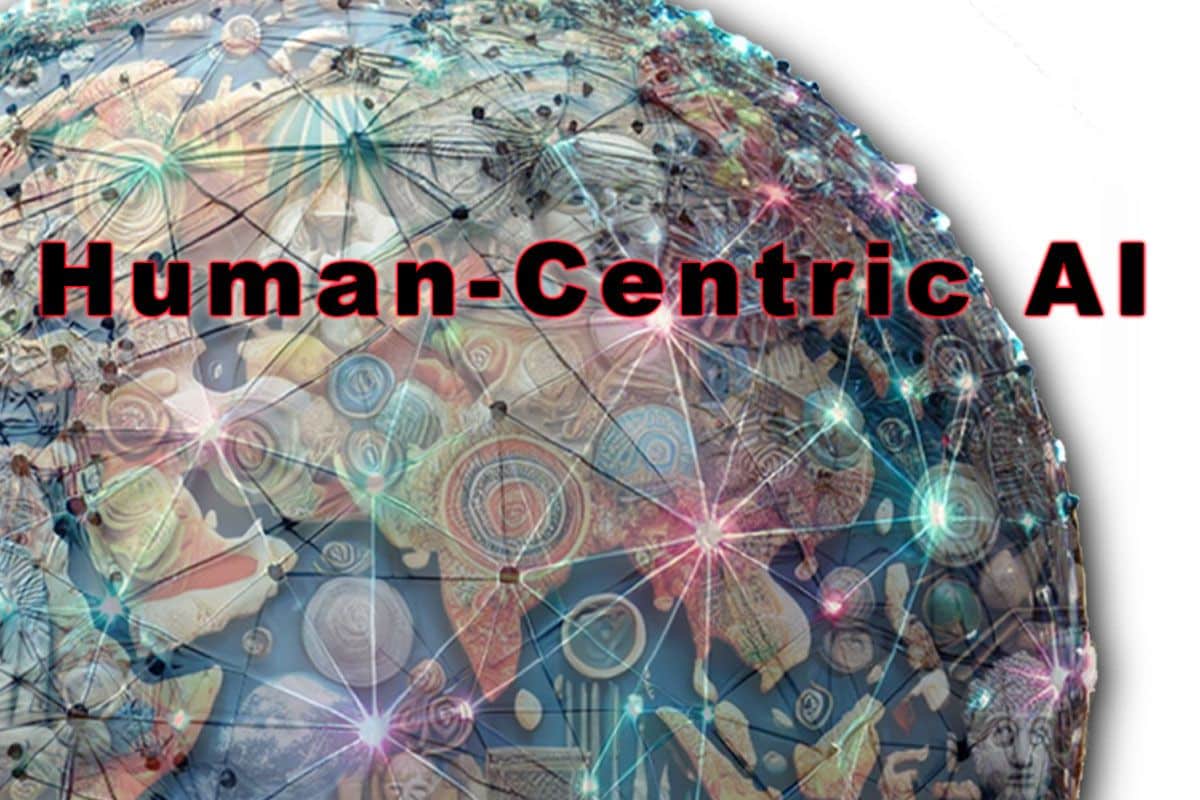
A Cultural, Ethical, and Human Call to Reimagine the Future of Artificial Intelligence
I’m writing this as someone who lives in two worlds that rarely speak to each other. My formal training is in the visual arts, art history and museum education, but my life’s work has been the arts—more than forty years across museums, education, community culture, and the full creative spectrum. For much of that time, I’ve watched how an enormous and expansive group of professionals come together to offer their communities opportunities to experience their our global cultural heritage first hand. .Their passion is to protect and preserve, what can’t be replaced: identity, language, story, and the meaning held inside objects and traditions. Over the last 24+ months, I spent time inside an incubator / entrepreneurial organization and an AI forum—rooms full of talented people talking about “innovation,” “scale,” and “the future.” What struck me wasn’t hostility toward the arts. It was absent. Creativity was treated as optional. Culture was treated as content. Universal Creative Intelligence—the human capacity to imagine, interpret, connect, and create—was almost never named as the foundation that makes innovation possible in the first place.
This isn’t an argument against AI. AI is here to stay, and it should. What I’m offering is a missing layer—something that can add depth to the AI arena without attacking existing systems: a way to ensure that the world’s cultural memory is included with consent, context, and stewardship, instead of being flattened into anonymous data.
The question nobody is asking loudly enough: who owns our global cultural heritage?
Every civilization is shaped by the memories it preserves. Those memories are not just books on shelves or objects behind glass. They live inside languages, rituals, ceremonies, scientific discoveries, artistic achievements, ecological knowledge systems, and the things communities create across centuries. They’re carried in a grandmother’s song, a tribal teaching that ties land to identity, a scientific record built decade by decade, a sacred object that protects lineage, or a painting that holds a nation’s emotional history. Together, these form the cultural memory of humanity—our global cultural heritage.
Yet in the age of artificial intelligence, a new and largely unspoken question shadows our future: who truly owns our cultural memory? Cultural heritage once belonged, in practice, to the communities who created it and to the institutions entrusted with its care. Now, fragments of that heritage are being pulled into modern AI systems—often without permission, without cultural context, and without the ability to preserve meaning. What once lived as a fully rooted human experience risks becoming an anonymous data point in a machine that cannot reliably distinguish ceremony from entertainment, sacred from casual, or heritage from trivia.
This is not primarily a technical question. It is a cultural and ethical one—about identity, belonging, representation, power, and the future of every community on Earth.
A modern “Library of Alexandria”: Sarajevo, 1992
When people hear “the Library of Alexandria,” some feel the weight of history; others shrug because it feels distant. So let’s take a modern, unmistakable example. In August 1992, during the siege of Sarajevo, the National and University Library of Bosnia and Herzegovina—housed in the landmark Vijećnica building—was intentionally destroyed. This wasn’t collateral damage. It was an assault on cultural continuity: scholarship, records, language, and the civic memory of a multi-ethnic society. When a library burns, you don’t just lose paper. You lose reference points. You erase bridges between generations. You weaken a community’s ability to tell its own story with clarity and proof. UNESCO+1
And Sarajevo is not alone. From the destruction of libraries and manuscripts in Mosul under ISIS, to repeated threats against the manuscript heritage of Timbuktu, history keeps repeating one lesson: when cultural memory is attacked—physically or systematically—the damage is not only academic; it is personal, political, educational, and generational.
What’s different now is that cultural loss doesn’t require fire. It can happen quietly through extraction, distortion, and default “interpretation” by systems that were never designed to carry meaning.
The scope of the human story: institutions that hold our memory
To understand what’s at stake, we have to see the scale. Around the world, there are countless museums, libraries, tribal cultural centers, archives, universities, historical societies, and community organizations dedicated to preserving what matters most—knowledge, heritage, and meaning. They hold manuscripts, research, scientific data, maps, drawings, recordings, films, and living cultural records. They also protect knowledge that is fragile, untranslated, undigitized, or carried through oral tradition and lived practice.
Taken together, these stewards represent one of the largest and most diverse collections of human knowledge ever gathered. Yet much of it remains outside the AI universe—not because it lacks value, but because it lacks digitized presence, commercial incentive, or standardized access. And even when it is digitized, meaning is not automatically preserved. Meaning requires context, governance, and cultural protocols.
How AI “sees” the world: patterns without context
Despite common assumptions, modern AI does not “know” the world the way humans do. It learns patterns from what it can access—usually content that is digitized, licensed, scraped, or otherwise available at scale. Entire languages and knowledge systems are underrepresented or absent. Oral traditions may be invisible. Local archives may be inaccessible. Cultural materials may appear without the context that makes them truthful.
Even when AI systems ingest cultural material, they do not inherently understand it. They transform it into statistical relationships: words become tokens; images become feature patterns. A ceremonial song becomes text. A story with spiritual lineage becomes plot structure. A painting becomes shapes and colors. Without deliberate stewardship, cultural material is easy to misinterpret, remix out of context, trivialize, or misrepresent—especially when AI outputs become the default “explanation” that millions rely on.
This is where the risk becomes real: when meaning is stripped, culture gets flattened. When culture is flattened, identity becomes fragile. And when identity becomes fragile, communities are more vulnerable to erasure—not always through hatred, but through careless automation at scale.
The physical reality behind the digital future: the AI infrastructure buildout
At the same time, AI is driving a massive physical buildout: data centers, power infrastructure, cooling systems, water systems, and supply chains. This is not abstract. Data centers already represent a meaningful share of global electricity use, and projections show rapid growth this decade as AI demand increases.
These facilities require land, power, water, equipment, and long-term grid planning. Some large data centers can consume extraordinary amounts of water for cooling—enough to meaningfully affect local planning and public debates, especially in drought-prone regions.
And the cost is enormous. McKinsey research estimates data center capital expenditures could total about $6.7 trillion globally by 2030 to meet demand, with a significant portion attributed to AI-ready capacity.
Whether you view this buildout with excitement, concern, or both, the direction is clear: the world is investing at historic scale in the infrastructure of intelligence.
The hidden imbalance: when communities carry the costs but don’t receive the benefits
Where the conversation often breaks down is at the community level. Localities are frequently asked to host large computing facilities with promises of growth, prestige, and jobs. Sometimes those benefits arrive. Sometimes they don’t. Often, the economic and environmental tradeoffs are uneven: construction jobs are temporary; ongoing staffing can be relatively small; and public incentives, utility upgrades, or planning concessions can shift burdens onto communities.
Here’s the point that matters for this article: if we’re going to build the infrastructure of intelligence, the public must not be left holding the costs while losing ownership of its cultural memory. Cultural stewardship can’t be an afterthought. It must be designed into the future.
The opportunity: a Global Cultural Heritage Data Network (AI-powered, community-governed)
This is where the solution becomes not only possible, but compelling.
A Global Cultural Heritage Data Network is a distributed, community-owned, culturally governed infrastructure that protects provenance—the source, meaning, and lineage of every artifact, story, object, document, teaching, and scientific record. It ensures cultural material is not stripped of context or separated from the people and institutions responsible for stewarding it. It gives communities and cultural institutions the ability to decide:
- what is shared and what is not
- what requires permission, protocol, or restricted access
- how materials are described (metadata) and interpreted
- how value is returned to the stewards and communities
- how AI systems can responsibly learn from cultural knowledge without flattening it
This is not about “replacing” today’s AI platforms. It’s about upgrading the ecosystem—adding depth, representation, and ethical structure so AI reflects a fuller human reality.
Why decentralization matters: resilience, fairness, and cultural truth
Centralization makes systems efficient—but also brittle. When knowledge, compute, and interpretation concentrate into fewer hands, communities lose agency. A distributed network does the opposite. It’s more resilient (no single point of failure), more equitable (more voices included), and more accurate (context preserved). It mirrors how human intelligence actually works: not stored in one vault, but spread across interconnected systems that reinforce meaning through relationships.
The community upside: jobs, education, revenue, and civic strength
Here is where the “yes” lives—because this isn’t only a protection plan. It’s a development plan.
A Global Cultural Heritage Data Network can generate long-term work in digitization, preservation, metadata creation, software development, IT maintenance, research, education, translation, and community engagement. It can create revenue pathways through ethical licensing, partnerships, teaching modules, cultural tourism, and local workforce training programs tied to cultural institutions. It can strengthen local universities, libraries, and museums as economic anchors and civic stabilizers.
Most importantly, it reframes cultural institutions properly: not as charitable extras, but as essential infrastructure. They don’t drain resources—they circulate them. They don’t extract value—they generate it by strengthening education, identity, entrepreneurship, and community investment.
The Opportunity: This Can Be Built — And It Can Happen Faster Than We Think
The most common reaction to a Global Cultural Heritage Data Network is, “That sounds enormous.” And it is—because what it protects is enormous. But “enormous” does not mean impossible. It means worthy of coordination. The world has built things of comparable complexity before, not by waiting for perfect conditions, but by aligning the right people around a clear purpose and allowing the system to grow step-by-step.
We don’t need to prove that humans can build transformational infrastructure. We already have. In the 1970s, Steve Jobs and Steve Wozniak helped launch what became Apple—one of the most influential organizations and economic engines in modern history—starting with almost nothing by today’s standards. That story matters here because it reminds us of a simple truth: when a vision is clear, when timing is right, and when talent and commitment converge, scale happens. And in the age of AI—where coordination, communication, translation, training, and problem-solving can move faster than any era before—the time between “idea” and “global network” is shorter than most people realize.
A Global Cultural Heritage Data Network doesn’t require a single heroic institution to carry the whole weight. It invites an alliance: museums, libraries, archives, universities, tribal nations, scholars, technologists, philanthropic partners, and responsible private-sector leaders—each contributing what they already do best. The opportunity is not only cultural; it is educational and economic. It creates meaningful work. It strengthens local institutions. It elevates community identity. And it builds a new standard for how AI can learn from humanity with consent, context, and accuracy.
The point is not whether this can be done. It can. The question is whether we can recognize the opportunity early enough—and come together with the seriousness and optimism it deserves.
Build an AI future grounded in culture, not consumption
We can continue down a path where cultural memory is absorbed into systems that were never designed to preserve meaning, leaving communities underrepresented and culturally flattened. Or we can choose a future where cultural heritage remains in the hands of the people and institutions that steward it—protected, governed, and accurately represented.
This is not anti-technology. It is pro-human. It is pro-culture. It is pro-ethics. And it is pro-opportunity.
If we act together—across institutions, communities, cultures, universities, and forward-looking business leadership—we can build an AI future that reflects the full depth of humanity rather than a convenient slice of what happened to be digitized and scalable. We can ensure the next century is defined not by loss, but by preservation; not by flattening, but by understanding; not by centralized interpretation, but by collaboration.
This is our moment to protect the story of humanity itself—and, at the same time, to create a new economic and educational opportunity that strengthens communities instead of draining them.
So here is my question: if we can build human-centric AI at a global scale, why wouldn’t we build the cultural stewardship that makes it wiser, truer, more inclusive, human and global?
Marty Treinen is the co-founder of Creative Core International and the co-creator of Universal Creative Intelligence™ (UCI), a groundbreaking framework that teaches people of all ages the creative, emotional, and cognitive skills needed for lifelong success. An artist, educator, storyteller, and project leader, Marty draws on a decades-long career spanning fine arts, theater, film, design, and museum education. Marty and co-author Dr. D. Wesley Spencer wrote the ground breaking book Universal Creative Intelligence™: How the Arts and Sciences Propel Human Advancement and is currently developing UCI programs for schools, universities, and businesses.
His mission is simple: equip people with the creative intelligence to build the future they deserve.
As a columnist for The Palm Springs Tribune, Marty covers theater, film, visual and performing arts, human-centric AI, and cultural events throughout the Coachella Valley. His reviews are known for their honesty, authenticity, clarity, and deep respect for the power of the arts, to enhance our lives.
service.to.others.cci@gmail.com