


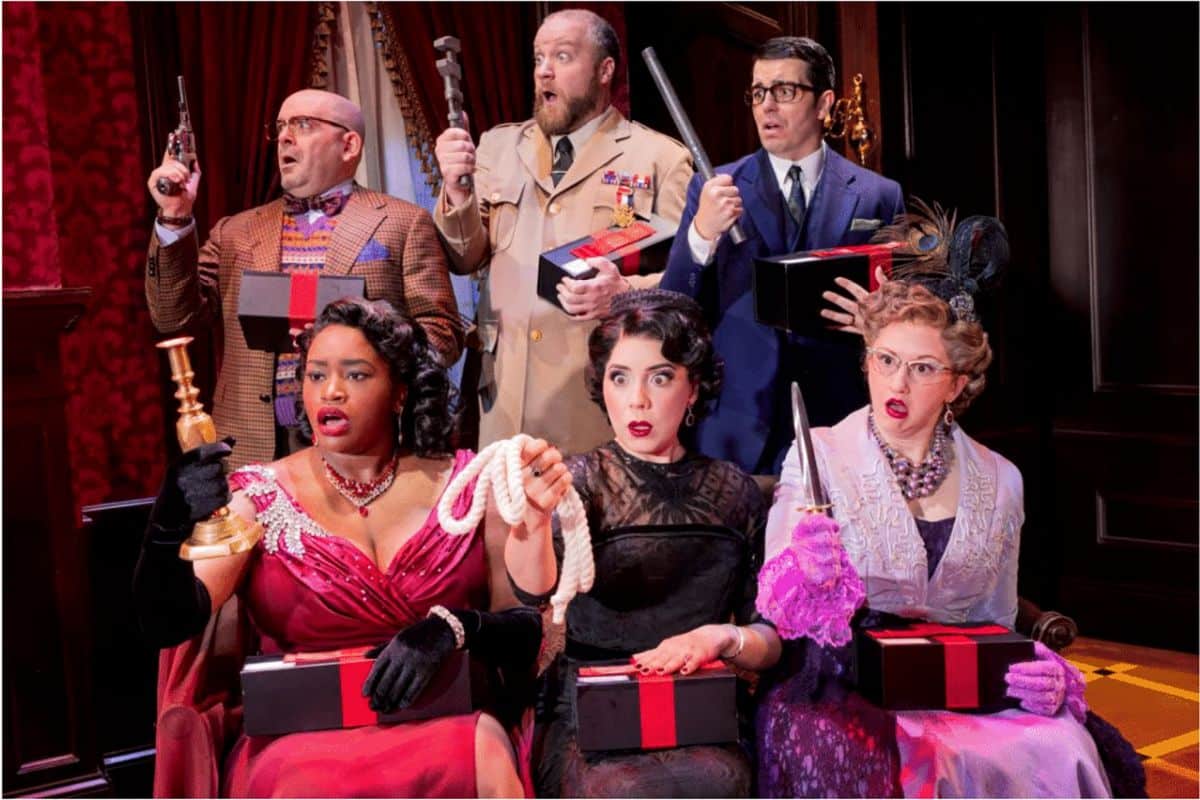
Channeling Benny Hill—minus the naughty bits
Palm Desert, CA
If you come to Clue: Live on Stage! expecting the board game you grew up with—quiet deduction, careful note-taking, and that slow, satisfying click of logic—this production will lovingly steal your pencil, slam a door in your face, and then sprint past you down the hall with the candlestick.
Yes, the familiar DNA is here: the names, the weapons, the rooms, the whole “Was it Colonel Mustard in the library…?” setup. In the press release it even describes it exactly as it is: a live whodunit built from the 1985 film and inspired by the Hasbro game, written for the stage by Sandy Rustin (with additional material by Hunter Foster and Eric Price). But what unfolds in front of you is not a game on a board—it’s a tightly engineered comedy machine.
The house as the hidden co-star: a set that keeps unfolding secrets
Let’s start with the single biggest delight of the evening: the set. The stage begins as a clean, contained square—almost like the lid of a game box—and then it starts to reveal itself. Rooms swing out. Walls fly in. New spaces appear just when you think you’ve mapped the manor in your mind. Full set pieces roll in to complete each location, and the production keeps moving so quickly that you don’t “watch a scene change”—you watch the house play along.
And that’s where the show earns a special kind of theater magic. In film, a cut does the work. In live performance, everything happens right in front of you—timing, choreography, lighting cues, door slams, reveals—every beat landing or missing in real time. That immediacy is the gift.
By the time the guests start flashing invitations at the door, Clue makes one thing clear: this isn’t a quiet puzzle. It’s a social pressure-cooker. Everyone walks in with an agenda, a secret, and just enough confidence to believe they can survive the evening—right up until the house begins rearranging itself like it has opinions.
And that’s where Wadsworth comes in.
Adam Brett’s Wadsworth is the evening’s stern traffic controller—the man trying to direct eight bad decisions through one narrow hallway without anyone noticing the walls are moving. He’s upright, by-the-book, and visibly offended by chaos… which is exactly why chaos keeps choosing him as its personal punching bag. His great gift is that he never “performs” the joke. He reacts like a person who’s one ruined schedule away from a breakdown, then keeps moving anyway. Precision under pressure, in a suit.
The suspects orbit around him like comets—each one convinced they’re the main character, and each one increasingly baffled that the universe won’t cooperate.
Camille Capers as Miss Scarlet doesn’t so much enter as arrive, armed with sarcasm, status, and the kind of smile that says she already knows what you’re hiding. She plays the room like a card game—controlled, watchful, strategic—until the night forces her to crack just enough for the audience to see the gears underneath.
Nate Curlott’s Colonel Mustard is confident without traction: bluster, medals, big declarations… and the unmistakable sense that if you handed him a map, he’d still walk into a wall. The comedy is that he keeps trying to behave like an authority figure while the show politely—and repeatedly—slips banana peels under his boots.
Then there’s Madeline Raube’s Mrs. Peacock, who feels like a fine china teacup with a loose lid. Wealthy, wound tight, and quick to hysteria, she doesn’t simply react—she erupts, and those eruptions become their own kind of music in the scene. Her panic isn’t random; it lands like punctuation.
Kyle Yampiro’s Professor Plum brings that academic self-certainty that always sounds impressive right up until it has to survive contact with reality. He’s arrogant, verbal, assured—then the physical world intervenes, and suddenly intelligence becomes a spectator sport. Watching certainty collide with motion is half the fun.
TJ Lamando’s Mr. Green is anxiety in human form: twitchy, careful, terrified of doing the wrong thing—and, of course, doing the wrong thing anyway. His fear becomes choreography. He doesn’t just panic; he moves like panic, and the audience reads it instantly.
And then there’s the quiet assassin of the whole bunch: Sarah Mackenzie Baron’s Mrs. White. Deadpan, stoic, and drenched in widow-energy, she stands in the middle of all this frantic overreaction like she’s waiting for someone to disappoint her properly. The running joke about her husbands works because she doesn’t chase laughter—she lets the room come to her.
Meanwhile, Zoie Tannous as Yvette is a spark plug—quick, flirtatious, and slippery in the best way. In a world of big personalities, she’s the one who can pivot on a dime and leave you wondering whether she’s naïve, clever, or simply enjoying the mess.
And the mansion isn’t only stocked with suspects—it’s stocked with interruptions.
Kebron Woodfin’s Cop is the closest thing the show has to a “regular guy,” which makes him invaluable: he smells nonsense like it’s his job (because it is), and he reacts the way the audience is thinking. AT Sanders’ Cook brings severity so straight-faced it becomes hilarious—like the kind of cafeteria authority figure who could stop a rebellion with one look. And Joseph Dalfonso’s Mr. Boddy sets the whole evening in motion with the kind of smug hospitality that practically begs the universe to do something violent.
Even the pop-in characters—the ones who appear at just the wrong moment, deliver a jolt of confusion, and vanish again—feel like the house itself is playing tricks. That’s part of why the show keeps you locked in: just when you think you’ve found the rhythm, a door opens and the rhythm changes.
The ensemble: fearless commitment (and one butler who earns hazard pay)
The cast succeeds because they commit—fully—to the ridiculous. That’s not easy. Farce is precision acting disguised as chaos.
What makes it all work is that nobody is acting alone. They’re playing off each other like trained comedians: listening, reacting, catching what’s thrown, and throwing it back without hesitation. The cast’s professionalism is the invisible scaffolding under the madness—because farce only looks easy when it’s done by people who are very, very good.
In a show like Clue, the jokes aren’t delivered—they’re caught. The dialogue is written like a series of traps: a character says one thing, another misunderstands it, a third reacts to the misunderstanding, and suddenly the room is laughing not at a “line,” but at a chain reaction. It looks effortless, but it isn’t. This kind of sparring comedy only works when actors react with genuine surprise—without telegraphing that they’re acting. That’s timing, and timing is trust. You can feel it when a cast is listening to each other, taking risks together, and staying sharp enough to land the same laughs night after night.
There’s a stretch in the middle of Clue where Wadsworth has to do what farce always demands of its smartest character: carry the recap and keep traffic moving while everyone else ricochets off the walls. It’s the kind of extended sequence that should wear out its welcome—because it’s long, because it’s dense, because it asks one actor to hold the whole room while the story is being re-threaded in real time.
The Laugh of The Night
On this tour, Adam Brett plays Wadsworth like a ringmaster with a stopwatch and a body made of rubber. He turns exposition into choreography—pivoting, doubling back, snapping into place, launching into motion again—never “selling” the joke, just executing it with precision. And the audience feels that discipline. You could hear it in the way laughter kept cresting instead of fading, and you could see it in the applause that broke out midstream, the kind that doesn’t happen unless a crowd realizes they’re watching something legitimately hard to do. The woman next to me said it out loud—how absolutely funny it was—and she wasn’t alone.
That’s the secret of great physical comedy: it looks inevitable, like it couldn’t possibly be done any other way. But you’re watching craft, timing, and trust—done at full speed.
Around them, the familiar suspects round out the night—Miss Scarlet (Camille Capers), Colonel Mustard (Nate Curlott), Mr. Green (TJ Lamando), Mrs. Peacock (Madeline Raube), Professor Plum (Kyle Yampiro), plus the supporting figures who keep the madhouse supplied: Yvette (Zoie Tannous), the Cook (AT Sanders) and the Cop (Kebron Woodfin), with Mr. Boddy played by Joseph Dalfonso.
The Comedy Engine: Benny Hill’s energy in a murder mystery suit
After the show, at the reception, I asked a question that felt like a litmus test: “How many of you grew up watching Benny Hill?” What I got back wasn’t a polite “yes.” It was bars of the theme—instant recognition, grins, and that specific kind of shared memory that only comes from physical comedy done at full speed.
For readers who didn’t grow up with it: The Benny Hill Show is a British sketch-comedy institution that ran from the mid-1950s through the Thames/ITV years (1969–1989), and it hit the U.S. hard through syndication starting in the late 1970s. Think doors, chase patterns, timing so sharp it feels musical—everything propelled by bodies in motion.
That is the spirit that lives inside this Clue. Not the “naughty bits.” Not the old-world leering. Just the kinetic architecture of farce: entrances and exits, disappearing acts, running in place, sudden reversals, and the joyful insanity of a company that trusts the rhythm.
And once you feel that rhythm, it’s hard not to connect it to the versions of Clue we’ve all played in our own homes—where the game isn’t really the point, the people are.
Why it hit home: our family’s Clue nights (and the “winner’s dance”)
When our kids were growing up, Clue at home wasn’t about solving a mystery so much as it was about the ceremony of competing. Our daughter Destiny and I would go back and forth—sometimes playful victory dances, sometimes mock outrage, sometimes that tense, theatrical “How could you do that?” That only happens in families who love each other enough to take a game way too seriously.
That’s the real connection this stage version made for me. Not the “rules.” The spirit: the sprinting energy, the sudden turns, the theatricality of the chase. It’s Clue as a shared experience—loud, physical, communal—built to make a room full of strangers laugh together.
My husband Marty—twenty-seven years and counting—will be the first to tell you he couldn’t survive in a farce. He loves the theater, he loves the people, he loves the energy, but ask him to memorize a stack of dialogue at speed and he’ll look at you like you just handed him a tax code written in Latin. I’ve always been the one who can hold the lines, and Marty has always been the one who reminds me what matters more: whether the actor looks like a human being having a real thought in real time. That’s why this cast impressed us. They weren’t performing “jokes.” They were playing a living, breathing game of reactions—fast, physical, and precise.
Curtain call truth: actors are entertaining offstage for a reason
One of my favorite parts of the night was meeting the cast and crew afterward. I love being around actors and have been most of my career. They typically have a kind of professional generosity: they know how to hold a conversation, how to give attention, how to make a moment memorable.
I had the pleasure of speaking with Sarah Mackenzie Baron, who plays Mrs. White. Her performance lands because it understands contrast: when everyone else is flying, she can freeze a moment with a deadpan look that makes the room laugh harder than a sprint.
And there’s always that second layer of fun: the audience member who meets an actor and can’t reconcile what they just saw with the person standing in front of them. “Wait—that accent was acting?” moment. The realization that the character was a crafted instrument—and now the human behind it is simply kind, present, and real.
That’s the quiet moral of live theater. It’s not only entertainment; it’s a reminder that human skill—trained, disciplined, performed in real time—still matters.
Verdict
Go see Clue if you want a night of speed, precision, and laughter—if you want a show that treats farce like choreography and stagecraft like a magic trick you’re allowed to witness up close. And if you meet Mrs. White or Colonel Mustard afterward, congratulate them. Any time you experience an artform, you’re receiving a gift—one made by living people, right there in front of you.
Location + contact
- Address: 73000 Fred Waring Drive, Palm Desert, CA 92260
- Box Office: (760) 340-2787 | Toll free (866) 889-2787
About the Author
D. Wesley Spencer, Ph.D ch©., is a writer, actor, director, arts educator, and He is the co-author of Universal Creative Intelligence: How the Arts and Sciences Propel Human Advancement, a book exploring how creative thinking shapes learning, leadership, and human progress.
He teaches communication at College of the Desert. Wesley brings a lifelong passion for theater and storytelling to every review he writes. As a columnist for The Palm Springs Tribune, Wesley covers theater, concerts, film, dining, local talent, and cultural events throughout the Coachella Valley. His reviews are known for their warmth, clarity, and deep respect for the power of the arts and the artists and communities they serve. All rights Reserved
service.to.others.cci@gmail.com
Universal Creative Intelligence: How the Arts and Sciences Propel Human Advancement