


Intent and reader promise
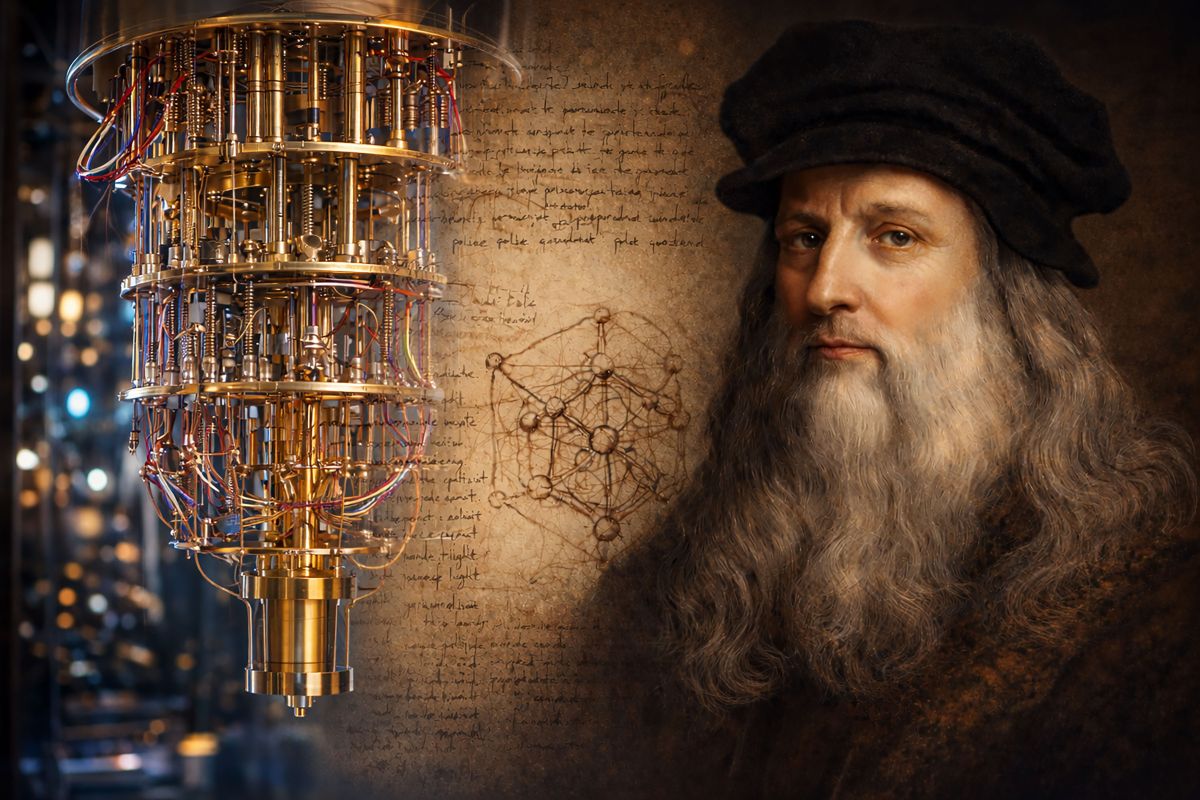
This article makes a simple, testable case: if education leaders want students to thrive in science, technology, engineering, and mathematics—and to do so with originality, adaptability, and ethical steadiness—then the arts must be restored as a foundational discipline, not a decorative add-on. Leonardo da Vinci is the clearest proof. Not because he is a romantic symbol of genius, but because his life shows, in concrete practices, that the arts and sciences are not opposing domains. They are different expressions of the same disciplined human process. They are two sides of the same coin—different in form, inseparable in function.
The problem STEM can’t solve by itself
Many STEM programs work hard to raise technical competence, yet too often graduate students can follow procedures inside a silo without being able to see across silos. That is not a minor weakness; it is the central failure mode of modern complexity. Real-world challenges do not arrive labeled “math,” “engineering,” or “computer science.” They arrive as systems, with multiple moving parts, human constraints, conflicting goals, and consequences. When students are trained in separated lanes, they may learn tools, but not the creative operating system needed to define what is happening, choose what matters, and design solutions that hold under real conditions.
This is where the arts are not merely helpful—they are essential. Studio practice trains the mind to stay in contact with reality: to observe closely, represent faithfully, revise relentlessly, and learn without ego. That discipline is not soft. It is the cognitive backbone of problem definition, modeling, iteration, and integration—the exact abilities the sciences depend on when they are doing their highest work. The arts and sciences should not be treated as rivals. They should be taught as complementary forces, each strengthening the other.
Why Da Vinci belongs at the beginning, not as enrichment
If we want an education model that reliably produces innovators, Da Vinci gives us the clearest demonstration of how it happens. His notebooks—filled with diagrams, drawings, observations, and experiments—show thinking in motion and make visible a learning method that modern schools rarely teach explicitly. Museums and research references often estimate his surviving notebook pages at roughly thirteen thousand, spanning wide-ranging inquiries and personal observations.
But the deeper point is not how many pages he left behind. It is what those pages are: a studio-lab record of a person learning from the world and then turning that learning into forms other people can use. This is the core move behind any durable knowledge: the conversion of lived experience into shareable models—sketches, diagrams, measurements, drafts, prototypes—that can be revisited, corrected, expanded, and carried forward across time.
Da Vinci matters because he shows us that art and science were never truly separate in the first place. In his hands, drawing was analysis. Painting was an investigation. Design was systems thinking. Observation was the beginning of both beauty and knowledge.
That principle does not belong to painting alone. It runs through the full range of the arts—storytelling, architecture, music, theater, dance, movement, design, film, sculpture, literature, and performance in all its forms. Leonardo may not have worked in every contemporary discipline as we now define it, but the underlying foundation is the same. All of the arts begin in human experience and in the disciplined use of the senses to engage the world, understand it, and transform that understanding into form. That is the common thread. Over the past five and a half centuries, the arts have expanded exponentially in mediums, tools, and applications, yet the core process has remained remarkably constant: perception, interpretation, construction, revision, and communication. In a contemporary educational setting, that matters enormously. Each art form develops capacities students need across every field—attention, empathy, structure, timing, visual and spatial reasoning, collaboration, communication, and the ability to turn lived experience into meaningful action. The arts are not peripheral to human development. They are one of its oldest and most essential training grounds.
There is another outcome of arts education that deserves far more attention: people do not simply learn how to make things. They learn how to invent, how to direct themselves, and how to lead their own lives. That is one of the great foundations of human development. The arts require choice, discipline, revision, courage, problem-solving, and the willingness to move through uncertainty until something meaningful takes form. In that sense, arts education does far more than prepare students to appreciate culture or produce creative work. It prepares them to become self-directed human beings capable of judgment, initiative, and leadership. Leonardo da Vinci stands as one of history’s clearest examples. He did not merely live during the Renaissance; he helped define what the Renaissance could become. His influence was not confined to his own century, and it has not ended in ours. He still teaches through the work itself, through the methods he modeled, and through the creative standard he set for artists, designers, inventors, and thinkers across the spectrum. Leonardo is not relevant because he belongs to history. He is relevant because the human powers he cultivated remain contemporary, necessary, and alive today.
The arts are not an add-on to STEM. They are part of the same engine.
When schools talk about adding art to STEM, the conversation often slips into appreciation—masterpieces, museum visits, creativity as inspiration. That has value, but it is not the core argument. The core argument is that art education—especially drawing and painting—trains a discipline of perception and construction that becomes the foundation of advanced thinking everywhere else.
Da Vinci did not depart from this. His art practice was not separate from his inquiry; it was the instrument of inquiry. Drawing trained him to see structure. Painting trained him to understand light, atmosphere, edges, and the subtle truth of form. Those same trained capacities later appear in anatomy, mechanics, optics, architecture, and design—not as disconnected subjects, but as different applications of the same disciplined way of learning.
That is the point education keeps missing. Art is not simply the “A” we add to make STEM more appealing. The arts help drive the very habits of mind that make the sciences inventive, humane, and capable of breakthrough. The arts and sciences are like yin and yang: distinct, but each incomplete without the other.
The Mona Lisa as applied science: light, anatomy, atmosphere
A powerful way to make this argument concrete—especially to academics—is to treat one famous artwork not as a cultural icon, but as a sustained research program. Musée du Louvre and art historians note that Leonardo began the Mona Lisa around 1503 and that it remained with him until his death in 1519, implying years of intermittent refinement rather than a single burst of production.
That matters because it shows the studio as a laboratory. The painting’s realism is inseparable from technical investigation—how light diffuses, how tone transitions create volume, how atmosphere softens edges, how subtle gradations affect the viewer’s perception of life in a face. The term sfumato is commonly used to describe fine shading that produces soft, nearly imperceptible transitions between tones and colors, associated strongly with Leonardo and used for both facial modeling and atmospheric effects. The British Library’s discussion of Leonardo’s optics emphasizes that he studied variables influencing the diffusion of light and connects his sfumato—tone and color shading—to those investigations.
In other words, one of history’s most famous paintings is also a case study in observation, experimentation, and perceptual engineering. It is an argument for why studio training belongs in the same seriousness category as laboratory training. Both disciplines teach students to work with reality, not merely with answers. Both ask the learner to look again, refine again, and tell the truth more accurately.
Learning in real time: the first-person source of meaning
Leonardo’s method is also a reminder of something modern education increasingly forgets: real learning is first-person. Learning in real time is the ability to learn from the world around you through the full range of human senses—seeing, hearing, touching, smelling, tasting—while you are still inside the experience. That sensory contact is not a poetic extra. It is where meaning forms and where perspective gains authenticity, because it is grounded in direct encounter rather than secondhand summary.
From that lived encounter comes a critical next step: giving experience a form that can travel. When a learner translates what they perceive into something physical, material, and concrete—a sketch, a diagram, a measured drawing, a written observation—they create knowledge that is transferable and shareable. That is what makes learning transcend time, space, culture, and language. This is not an idea left floating in the mind. It is the act of shaping an idea into a form that other human beings can test, understand, and build upon. Leonardo’s notebooks are a masterclass in exactly that conversion—experience into record, record into method, method into progress.
This is where the arts and sciences meet most clearly: both depend on direct contact with reality, and both depend on the disciplined act of giving that contact form.
Systems thinking: how the creative process becomes true innovation
Once students are trained to observe and represent accurately, they gain something more valuable than creativity as a mood: they gain the ability to define what is happening around them. Definition is the beginning of every real solution. A poorly defined problem can absorb unlimited intelligence and still produce failure, because the system keeps optimizing the wrong target.
From definition comes decomposition—the ability to break a complex challenge into its essential components and resolve them to a reliable standard. That is how modern engineering succeeds. Consider a space rocket: it is not one machine, but a system of systems, with countless interdependent components and unforgiving margins for error. One unresolved component can collapse the entire mission—failure on launch, failure in flight, failure to reach destination, or catastrophic loss. The lesson is not about rockets; it is about reality. Most meaningful achievements require multiple problems to be solved correctly and integrated into a whole that performs under stress.
Leonardo’s working habits point toward that modern standard. His drawings on light are not separate from his drawings on structure; his diagrams train the mind to track interdependence. The Royal Collection Trust’s “The fall of light on a face,” for instance, was intended to demonstrate how rays from a single point fall upon the face, accompanied by notes and diagrams about the action of light—an example of the mind treating art as a geometry-and-observation problem. This is systems thinking in studio form: analyze conditions, model relationships, refine until the whole works.
Again, the lesson is not that art supports science from the sidelines. The lesson is that the same creative process can produce both artistic excellence and scientific advancement.
Da Vinci’s proof is not only in paintings—it is in applied work
It helps school leaders to see that Leonardo’s approach moved fluidly into applied civic and engineering contexts. Working with Cesare Borgia, Leonardo produced a celebrated map of Imola in the autumn of 1502—an example of observation, measurement, and representation serving real-world decision-making. In later life, Francis I of France offered him the title “Premier Painter and Engineer and Architect to the King,” bringing him to what is now known as Clos Lucé, where he lived from 1516 until his death in 1519.
This arc matters because it destroys the false narrative that art is separate from real work. Leonardo’s studio discipline was the transferable foundation that allowed him to move from painting into engineering, from observation into systems, from private curiosity into public value. The arts did not distract him from science. They trained him for it.
The AI-era clarification: what machines can iterate, and what humans must supply
In today’s world, AI can generate variants, simulate options, prototype quickly, test parameters, and iterate at speed. That changes the surface of innovation, but it does not eliminate the need for grounded human judgment. What direct observation gives a student—or an inventor, or an engineer—is the ability to see and understand context: what is actually happening, what matters to human beings, where friction lives, what the environment is telling you, what constraints are real versus assumed. The student who has been trained in studio-lab observation can define better problems, set better constraints, and recognize when the system’s output is elegant but wrong.
Da Vinci is the prototype of this human advantage. He shows that the highest outcomes come not from abstract intelligence alone, but from trained perception, disciplined making, and the ability to translate reality into models that can be shared, tested, and refined. That human capacity sits at the center of both the arts and the sciences.
What it means to reintroduce Da Vinci through art education
Reintroducing Da Vinci is not about adding a unit on Renaissance art and calling it STEAM. It means rebuilding the front end of education through art studio labs and art history in a way that directly strengthens scientific and technical outcomes. Students learn to draw not as decoration, but as a tool for thinking. They learn light and atmosphere not as an art trick, but as perceptual truth. They study Da Vinci not as a hero story, but as a method: learn from the world, record what you observe, refine what you build, integrate what you understand.
When art education is restored in this way, STEM becomes stronger because it reconnects with the human capacities that made discovery possible in the first place. The arts supply the perceptual training, resilience, communication, and integrative thinking that make innovation reliable. They train students to work with uncertainty without shutting down, to revise without shame, to communicate complex ideas visually, and to carry methods across disciplines. These are the capacities that create sustainable success, because they remain useful even when tools change, industries shift, or future jobs do not yet exist.
Conclusion: the foundation that travels with students into any future
The lasting value of Da Vinci in education is not that students memorize what he did. It is that they learn how he learned. His studio practice restores what modern schooling too often strips away: first-person engagement with the world, disciplined observation, the conversion of experience into shareable form, and the integrative thinking required for complex systems.
If we want students to have a competitive advantage—not as a weapon against others, but as a durable strength that supports meaningful lives—then we must give them the tools that make excellence repeatable. Studio-lab art education, anchored by Da Vinci’s method and reinforced by art history, does exactly that. It restores the missing relationship between the arts and sciences and shows students that these fields were never meant to be divided. They are complementary forms of human advancement, each sharpening and extending the other.
That is the real lesson of Leonardo da Vinci. The future will not be built by choosing between the arts and the sciences. It will be built by teaching them together, as they always should have been: distinct, interdependent, and powerful enough, together, to help students create lives of meaning, innovation, and service.