


Palm Springs, CA
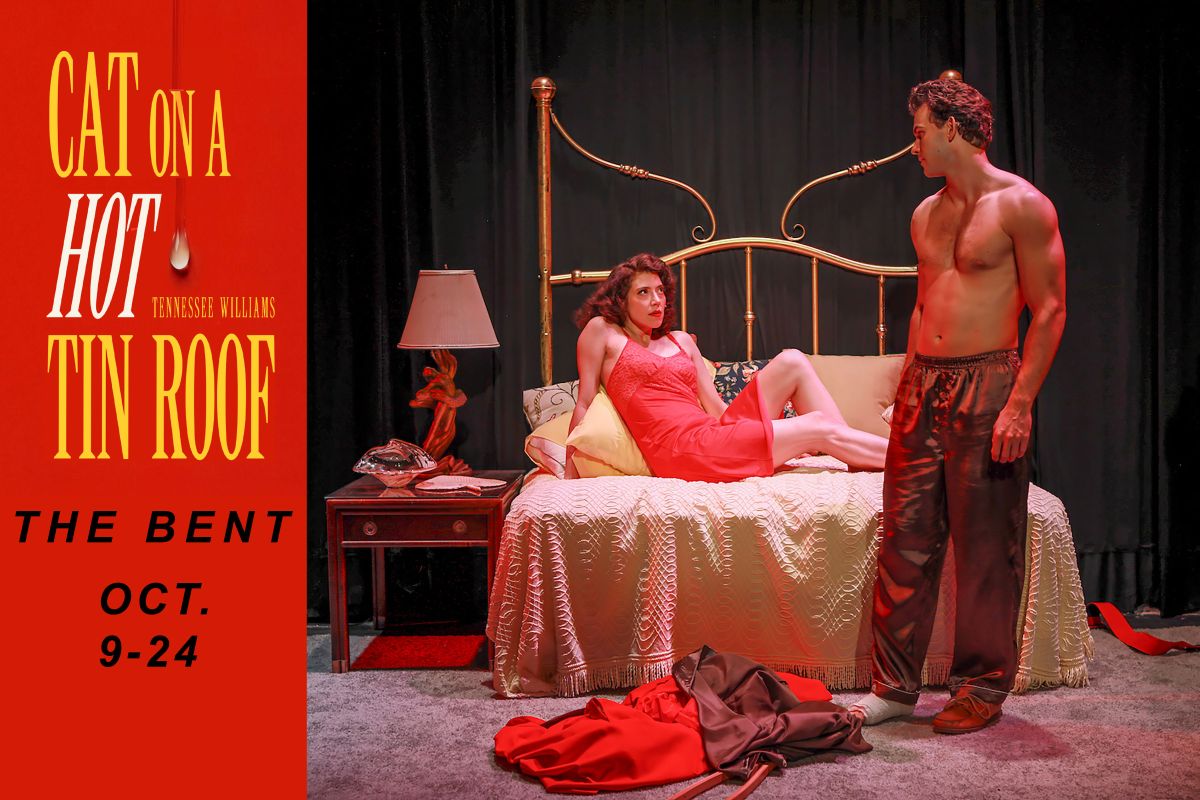
You might think you know Cat on a Hot Tin Roof. You might even think Tennessee Williams has become a little dated, a little talky, or perhaps a bit stale. After all, we have been watching his troubled Southern families wrestle with their secrets, lies, and disappointments for more than seventy years. But rest assured, Williams is alive and well at The Bent Theatre in Palm Springs, and this Cat still has plenty of claws.
I must admit that I went into this production with a little skepticism. I am a Williams lover, and that can be a dangerous thing when attending a new production of an old favorite. You know the characters, you know the language, and you certainly know how easily all that Southern passion can turn into something resembling a caricature. There is a fine line between playing Tennessee Williams and simply playing at Tennessee Williams. Fortunately, director Terry Ray understands the difference, and his production captures much of the magic that makes Williams such an extraordinary American playwright.
For those who may need a little refreshing, Cat on a Hot Tin Roof takes place in the Mississippi home of Big Daddy Pollitt, where the family has gathered to celebrate his birthday. But birthdays are hardly the point when there is an inheritance to consider, a marriage falling apart, and enough family secrets to keep everyone occupied well beyond the celebration. Maggie is desperately trying to save her marriage to Brick, who seems far more interested in his next drink than in his wife or anyone else. Around them, the family circles, schemes, and struggles to hold together a world that may already be coming apart. Williams gives us people who are not always particularly likable, but who are wonderfully, painfully human.
Branda Lock, as Margaret, or Maggie the Cat, immediately captured my attention. She creates a real and truthful character, which is not nearly as easy as it might sound. Maggie can become a collection of familiar Southern mannerisms in the wrong hands, but Lock avoids that trap. She understands that beneath Maggie’s determination and considerable verbal energy is a woman fighting for something she is terrified of losing. It is a performance that reminds us why this character has remained so compelling through the years.
Justin McEneny’s performance as Brick, like so many of the principal performances in this production, is exceptional. Acting that requires subtlety is not easy. It demands an extraordinary degree of control, particularly when a character says so little but must communicate so much. Nearly everyone around Brick has considerably more to say, and Williams gives them wonderfully substantial opportunities to say it. They carry much of the conversation, but Brick carries the heart of the story. He is constantly being talked to, talked about, confronted, and questioned, yet he remains remarkably uninterested in much of what is happening around him. McEneny understands that silence is not the absence of acting. His performance conveys an enormous amount through restraint, and he plays the part exceptionally well.
Another true standout is Michael Pacas as Big Daddy. This is a character who can easily become all bluster and booming authority, but Pacas finds something far more interesting. His portrayal is genuinely empathetic, allowing us to see the man beneath the considerable personality. Big Daddy is not always pleasant company, but he is a human being, and Pacas never lets us forget it. That is a considerable achievement in a role that practically invites an actor to chew the scenery.
Jessica Lenz as Sister Woman and Jason Ayestas as Brother Man are equally exceptional in creating two characters who could so easily become little more than familiar Southern stereotypes. Williams gives them plenty to work with, and they make the most of it. Sister Woman and Brother Man have their own interests in the family’s affairs, and neither is particularly inclined to let those interests go unnoticed. There is humor in these characters, certainly, but there is also a very real understanding of who they are and what they want. Lenz and Ayestas find that balance beautifully. They never allow the characters to become caricatures, even when the writing practically invites them to do so. Their performances are fully realized, entirely believable, and essential to the extraordinary ensemble Terry Ray has assembled.
Sonia Reavis as Big Mama brings another important dimension to this remarkable family. Along with Lenz, she finds moments of genuine laughter and comedy amid the family’s considerable turmoil. These moments are important because Williams understood that people do not stop being funny simply because their lives are falling apart. The humor gives the drama room to breathe, and Reavis understands how to find it without diminishing the emotional truth of her character. It is another example of the care and professionalism evident throughout this company.
Reverend Tooker, played by Kai Brothers, and Doctor Baugh, played by Mark Crowell, are relatively minor characters in the play, and their roles are necessarily limited by the scope of Williams’ story. Both actors fulfill those responsibilities with the appropriate restraint, moving the story forward when their characters are needed without attempting to make their roles something they are not. They deserve recognition for understanding that even the smallest parts contribute to the success of an ensemble. Neither performance needs to dominate the stage, nor should it. Their contribution is precisely what the production requires.
The appearance of Elijah Olachea as Skipper’s ghost is an interesting directorial choice, adding another dimension to a character whose presence is ordinarily felt rather than seen in Williams’ original play. Whether I would have made that particular choice is beside the point. What matters is that Terry Ray has a clear understanding of the play he is directing and has assembled a company capable of bringing that vision to life. His choices, both in casting and in guiding the performances, demonstrate an understanding of the depth of Williams’ work. The level of professionalism throughout this production is exceptional.
The production is also thoughtfully designed. Andrew Delatorre’s sound design is particularly masterful, contributing considerably to the atmosphere of the evening. Denee Lee’s costumes are gorgeous, and Chase Potter’s lighting is effective in helping establish the world of the play. The one limitation that cannot entirely be avoided is Steve Giboney’s scenic environment. The size of the performance space, together with the practical requirements of fire safety, necessarily places restrictions on what can be accomplished. But these limitations are minimal in their effect on the production. Ray never allows the physical constraints of the theater to interfere with the actors’ ability to inhabit their characters or tell the story. In fact, the strength of the performances makes the limitations of the set almost inconsequential. What matters is not how much scenery surrounds an actor, but what that actor is capable of creating within it.
What I particularly appreciated about this production is that it does not treat Williams as a museum piece. His plays are sometimes approached with such reverence that all the life gets polished right out of them. But Williams was writing about people, not monuments. His characters are filled with longing, jealousy, fear, affection, disappointment, and the desperate need to be loved. Those feelings have not become dated, and neither has the extraordinary language he gave them. Under Terry Ray’s direction, this company understands that the power of Williams comes not from playing the drama as loudly as possible, but from finding the truth beneath it.
For The Bent, a company devoted to telling stories that illuminate the human experience, Cat on a Hot Tin Roof is a fitting way to open its fifth season. The play’s questions about truth, identity, desire, and the things we are unwilling or unable to say remain as relevant as ever. Great theater does not survive simply because it is famous. It survives because each generation of artists finds a way to make it live again. This company has done exactly that.
Perhaps the greatest compliment I can give any actor is that, from the beginning of a performance to its conclusion, I believe completely in the person standing before me. I no longer see someone playing a character. I see that character, with all the contradictions, peculiarities, weaknesses, and humanity that make a person who they are. That is no small accomplishment, particularly in a play populated by personalities as complicated as those created by Tennessee Williams. By the end of this production, I was so thoroughly convinced by these performances that I felt I could have walked up to any one of these people afterward, introduced myself, and met exactly the person I had just spent the evening watching.
I arrived a little suspicious, wondering whether another visit with the Pollitt family was really necessary. I left reminded of why I fell in love with Tennessee Williams in the first place. The Bent has given us a Cat on a Hot Tin Roof that feels alive, human, and remarkably fresh. And for me, that is acting, and theater, at its finest.
Cat on a Hot Tin Roof runs October 9–24, 2026, at The Bent Theatre in the Palm Springs Cultural Center. Tickets and additional information are available at thebent.org.
D. Wesley Spencer, Ph.D., is an educator, writer, and arts advocate whose work spans communication, performance studies, and creative development. He earned his doctorate in Performance Studies from Northwestern University and has taught communication and theatre at institutions including College of the Desert and Glendale Community College. A former Executive Director of the Las Vegas Shakespeare Company, Wesley blends academic rigor with a genuine love for community-based arts.
He is the co-author of Universal Creative Intelligence: How the Arts and Sciences Propel Human Advancement, a book exploring how creative thinking shapes learning, leadership, and human progress. He also co-created Universal Leadership Education, a program that can teach anyone to become an exceptional leader.
As a columnist for The Palm Springs Tribune, Wesley covers theater, concerts, film, local talent, and cultural events throughout the Coachella Valley. His reviews are known for their warmth, clarity, and deep respect for the power of the arts. servicetoothers.uci@gmail.com
Universal Creative Intelligence: How the Arts and Sciences Propel Human Advancement
© 2026 Wesley Spencer All Rights Reserved. Use the email above to contact the author.
Photos by Jim Cox © All Rights Reserved