

Palm Springs, CA
Watching Dada Woof Papa Hot is a little like watching Who’s Afraid of Virginia Woolf? You know that bad things are going to happen and bad choices are going to be made, but the train is already on the tracks, and there is nothing you can do to stop it. And that is why we keep coming back to stories like this. Society, and perhaps psychology, wants us to form these family units—chosen or biological—for security. But in fact, nothing is more fragile than our feelings and relationships. Once that vase is broken, it can never be put back together perfectly. There are always cracks or chips, and in some cases, it is best to just throw it out.
We have been telling stories about troubled families for thousands of years. The ancient Greeks gave us fathers who feared their sons and sons who destroyed their fathers. The Bible gave us fathers willing to sacrifice their children and others willing to forgive them almost anything. Shakespeare understood that families could be as dangerous as they were comforting, and Edward Albee certainly understood that marriage was no guarantee of happiness. Yet somewhere along the way, we developed this idea that marriage, children, and the nuclear family were supposed to give us stability, security, and perhaps even happiness. What is particularly interesting is that the nuclear family, once considered unstable by nineteenth-century social researchers because it separated generations, eventually became the American ideal of stability. Apparently, we have been changing our minds about what makes a family work for centuries, without ever quite figuring it out.
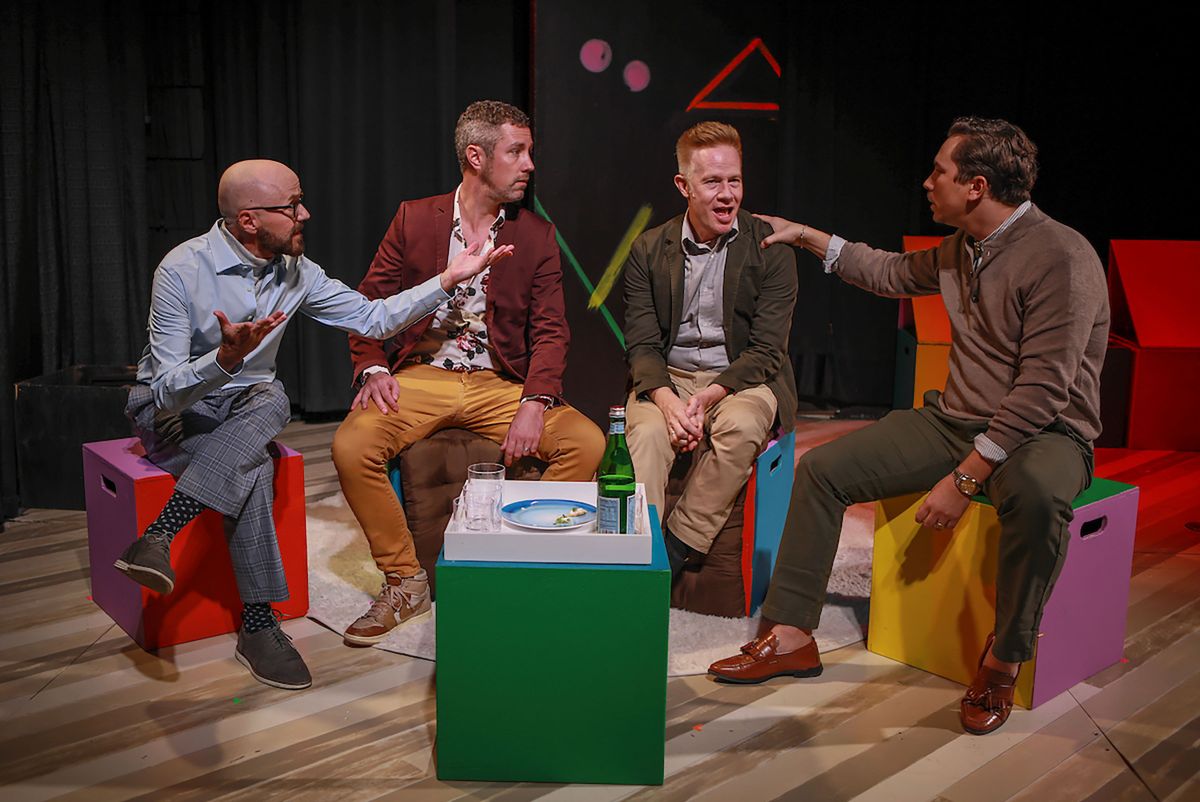
Peter Parnell’s Dada Woof Papa Hot, presented by The Bent in Palm Springs, explores what happens when gay men achieve the very things earlier generations fought to make possible: marriage, children, and the freedom to build families openly. But having the opportunity to create a family does not necessarily prepare us for living in one. Love, marriage, sex, friendship, and parenthood bring their own expectations, and sometimes those expectations become impossible to reconcile. What makes the play interesting is not simply that these are gay families, but that they are families confronting the same difficult questions that have challenged relationships for generations.
Jerome Joseph Gentes directs the show and brings out emotions through perfectly subtle moments between actors that give the characters depth beyond simply being frustrated gay dads. If I have a criticism of the play, it is that Parnell’s characters sometimes feel more like archetypes than people. Luckily, Gentes’ direction fills in those gaps. He allows the actors to find the vulnerabilities beneath their characters’ behavior, reminding us that people are rarely as simple as the choices they make.
The cast members are masterful storytellers, and much of the production’s success comes from the way they make these complicated relationships recognizable. Jenne Carey (Serena) brings an energy to the stage that is refreshing and never falls into the tired-mom stereotype that would have been too easy. I really wanted to see more from this character. Sarah Elizabeth Woolsey (Julia), the other woman in the play, gives voice to someone who is much more than a bored housewife. There is a longing in her performance that makes you want her to have more than she feels she does. Both performances remind us that the desire for something more in life is hardly exclusive to the gay men at the center of the story.
Michael, played by Ronald Douglass, is a straight man in the gay world of Broadway musicals. He is really fun to watch, and his performance provides some much-needed comic relief. But even the humor serves a purpose in a play where everyone seems to be negotiating the differences between the lives they imagined and the lives they are actually living.
Anthony Nannini (Scott) brings to life a character we all know too well—the Log Cabin gay—and gives him empathy, not just sympathy. That distinction matters because it would be easy to dismiss Scott as simply a familiar political or social type. Nannini gives us someone more complicated. John Corr (Jason) commands the stage and embodies a very sexual person. He gives Jason a confidence that could almost be arrogance, but he allows us to see his vulnerability from time to time and never plays him simply as the villain of the show. Both actors remind us that confidence and conviction do not necessarily protect anyone from insecurity or the consequences of their choices.
LT Cousineau (Rob) is the dad we wish we all had. Attentive, adoring, and maybe just a little smothering, he is nevertheless a very good dad. He is also a loving husband who is taken for granted. Cousineau never plays him as bitter, but rather as vulnerable, and that takes real talent. His performance is especially moving because Rob seems to have invested so much of himself in the family he loves. We can see how deeply he cares, and that makes the possibility of losing what he has built all the more painful.
Finally, J. David rounds out the cast as Alan. David is in virtually every scene, and the play really tells his story: a survivor who lived through the AIDS epidemic and is now surviving parenthood and marriage as best he can. There is something particularly compelling about that journey. For gay men who lived through the epidemic, the possibility of growing older, marrying, and raising children was not always something they could take for granted. Yet surviving one chapter of life does not necessarily prepare us for the next. I never got tired of watching David navigate every choice. He reminds us that life is a series of choices and lessons in love, and that even after everything we have experienced, we are still capable of making mistakes and hurting the people who matter most.
The lighting, set, and costumes were all effective, but I think the one design choice that really stood out was the use of sound. The constant, ever-present sounds of children throughout the show were masterful. Their presence is felt even when they are not seen, and that becomes an important part of the storytelling. These are not simply couples negotiating their relationships with one another. They are parents whose decisions extend beyond themselves. The children are always there, reminding us that the choices adults make have consequences for the families they have created.
Gay parenting is still relatively new to society, at least when it comes to openly gay parents being able to build families without hiding who they are. For generations, gay men fought for the opportunity to live openly, love openly, and have their relationships recognized. But achieving those freedoms does not mean we suddenly know how to make those relationships work. We bring our histories, expectations, insecurities, the misconceptions of the American version of the nuclear family and desires into our marriages and families just as everyone else does. And perhaps that is one of the most important things this play has to say. Gay families do not need to be perfect to deserve recognition, and gay relationships do not need to succeed to have been meaningful.
I thank the playwright, director, cast, and The Bent for giving these experiences a voice. What Dada Woof Papa Hot reminds us is that there is no perfect family, and perhaps there never was. We have spent centuries defining what a family should look like, but we are still trying to understand how to live together, how to love one another, and how to survive the choices we make. Marriage and parenthood may give us a family, but they do not come with instructions for keeping it together. Sometimes the vase can be repaired, even if the cracks remain. Sometimes it cannot. And that is why we keep returning to stories like this. We recognize ourselves in the people onstage, even when we wish we didn’t.
Production Information
Dada Woof Papa Hot by Peter Parnell, directed by Jerome Joseph Gentes, is presented by The Bent at the Palm Springs Cultural Center, Theater 3, 2300 E. Baristo Road, Palm Springs, California. The production runs through November 29, 2026. For tickets and additional information, visit www.thebent.org.
About the Author
D. Wesley Spencer, Ph.D., is a writer, actor, director, arts educator, and co-founder of Universal Creative Intelligence LLC and the co-creator of Universal Creative Intelligence™ (UCI), a groundbreaking framework that teaches people of all ages the creative, emotional, and cognitive skills needed for lifelong success.
He teaches communication at College of the Desert. Wesley brings a lifelong passion for theater and storytelling to every review he writes. As a columnist for The Palm Springs Tribune, Wesley covers theater, concerts, film, dining, local talent, and cultural events throughout the Coachella Valley. His reviews are known for their warmth, clarity, and deep respect for the power of the arts and the artists and communities they serve. Look for him within the local community theaters, as he follows his passion, to both act and direct.
As a columnist for The Palm Springs Tribune, Wesley covers theater, film, and performing arts, arts education and cultural events throughout the Coachella Valley. His reviews are known for their honesty, authenticity, clarity, and deep respect for the power of the arts, to enhance our lives.
They are currently developing the Introduction To Universal Human Intelligence Education ™ programs for individuals, students, educators, colleges and universities.
© Wesley Spencer 2026 All Rights Reserved