

Palm Springs, California
I have to admit that Urinetown: The Musical has never been one of my favorite dark comedy musicals. Yet the current production at Revolution Stage Company in Palm Springs, directed by James Owens, proved to be both entertaining and, perhaps more importantly, relevant to the world we are living in today. The musical performances throughout the cast were professional, the ensemble worked together with an impressive sense of timing and coordination, and the principal actors delivered their characters with clarity, energy, and conviction. There were technical imperfections, as there often are in live theater, but they did not overshadow what I found to be a worthwhile evening. In fact, it was the following day, after I had time to consider what I had seen and heard, that the musical’s larger implications began to emerge.
The premise is deliberately ridiculous. Following a twenty-year drought, the population of an imaginary city is prohibited from using private toilets. Everyone must pay to relieve themselves at public facilities controlled by the Urine Good Company, a corporation whose wealthy owner, Caldwell B. Cladwell, has effectively purchased the cooperation of the political establishment. The company controls the fees, the government enforces the regulations, and the police ensure compliance. People who cannot afford to pay are faced with the impossible choice of either enduring their most basic biological needs or breaking the law. Those who refuse to comply are taken away to a mysterious place known as Urinetown, from which no one returns.
Now consider that premise without the comedy. A population already struggling financially is subjected to a system in which its most elementary human needs have become an opportunity for corporate profit. The people controlling the system manipulate government through money, power, and influence, while those with the least resources carry the greatest burden. Even the most basic human act, emptying one’s bladder, has been transformed into a source of revenue. It is difficult to imagine a more reprehensible form of organized financial extraction. And yet the absurdity is what makes the musical work. By reducing the question of corporate control to something every human being must do, the writers expose an underlying reality that would be considerably less entertaining if presented as a conventional political argument.
The musical was created by Greg Kotis, who wrote the book and co-wrote the lyrics, and Mark Hollmann, who composed the music and co-wrote the lyrics. Its origins are an interesting example of how an ordinary experience can lead to something far more consequential. While traveling through Europe with very little money in the mid-1990s, Kotis encountered public toilets that required payment. His own financial circumstances made even that small expense significant. From that experience came the idea for a society in which access to an unavoidable human necessity could be controlled by a single corporation. The show premiered at the New York International Fringe Festival in 1999 before moving Off-Broadway and then to Broadway in September 2001, eventually winning three Tony Awards.
The political circumstances surrounding its development are worth remembering. The late 1990s were years of economic expansion, but they were also marked by growing concerns about corporate globalization, environmental sustainability, and the distribution of wealth. In November 1999, the same year the musical first appeared, enormous demonstrations surrounding the World Trade Organization meeting in Seattle brought questions of corporate influence, workers’ rights, public accountability, and environmental responsibility into the international spotlight. The musical was not written in response to those particular demonstrations, but both emerged from a period in which many people were questioning whether powerful economic institutions were adequately accountable to the populations affected by their decisions.
Its Broadway opening brought another unexpected historical connection. Urinetown opened on September 20, 2001, only nine days after the terrorist attacks of September 11. The production had been created years before those events, but it arrived before an American audience suddenly confronting new questions about fear, security, authority, and the relationship between individual rights and collective responsibility. A musical about an oppressive system that exercises control over everyday life has acquired a new context. Twenty-five years later, its questions about government, corporate influence, economic inequality, and the limits of public freedom have hardly disappeared.
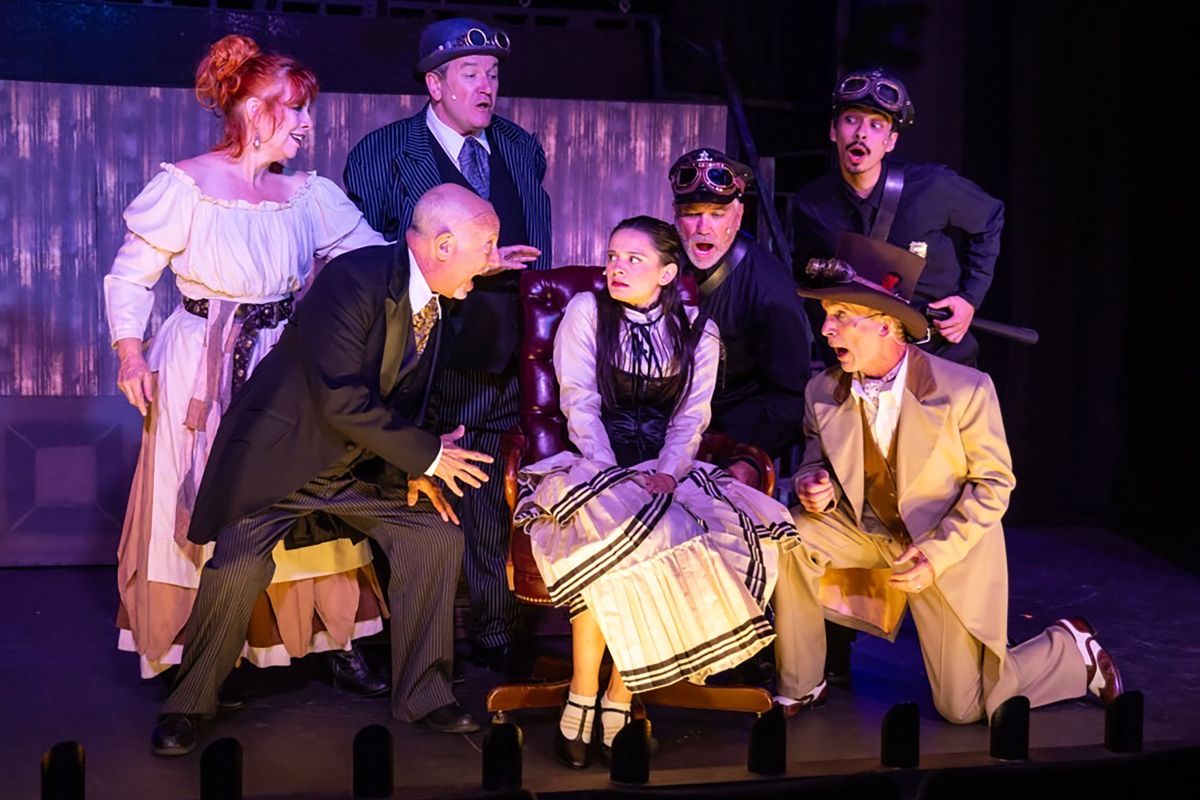
At Revolution Stage Company, those conflicts are brought to life through a cast that understands the importance of playing this exaggerated material with conviction. Carlos Garcia portrays Bobby Strong, a young man whose rebellion begins when his own father is arrested for being unable to afford the price of using a public toilet. Paul Crane plays Caldwell B. Cladwell, the wealthy corporate leader whose authority depends on the relationship between business and government. Leilani Baldwin portrays Hope Cladwell, the businessman’s daughter, whose growing relationship with Bobby introduces the familiar theatrical conflict between wealth and poverty, privilege and deprivation, and love and loyalty. These principal performances establish the relationships that make the story understandable even when the circumstances around them become increasingly outrageous.
The relationship between Bobby and Hope is especially important because it introduces something that the corporate and political structure has almost entirely eliminated: the possibility of acting according to one’s conscience. Hope encourages Bobby to listen to his heart in the song “Follow Your Heart,” unaware of how directly that advice will challenge her father’s authority. Bobby, already troubled by his inability to protect his father, begins to recognize that the regulations he has accepted are not necessarily just. The resulting rebellion places the two young people on opposite sides of the very system that has defined their lives. Hope is torn between the father whose wealth and position have protected her and the young man whose circumstances have exposed the consequences of that protection.
There is something both familiar and disturbing about that relationship. The story of two people from different social classes falling in love is hardly new, but here their affection becomes the catalyst for a confrontation with an entire political and economic structure. Bobby’s father has been condemned by the authorities, while Hope’s father controls the corporation that benefits from those authorities. The police, represented in part by Officer Lockstock, played by Willie Eide, are more than a means of enforcing the law. They are essential to the system’s survival. What initially appears to be a ridiculous tale about public toilets becomes a story about who writes the rules, who profits from them, and what happens to people who refuse to obey.
The rebellion itself provides the musical’s most important complication. It is tempting to imagine that removing the corporation and freeing the population from its financial burden will solve everything. But Urinetown does not allow its audience that comfortable conclusion. Bobby’s struggle has terrible consequences, and when Hope ultimately assumes leadership, the new system proves incapable of protecting the very resources upon which the population depends. The authorities’ exploitation was morally indefensible, yet the environmental scarcity that helped make their control possible was real. The musical’s dark conclusion exposes the difference between defeating an oppressive system and developing a sustainable alternative. Freedom, justice, compassion, and responsibility are not separate questions. They must coexist.
For me, that is where the story begins to extend into present-day America. We continue to confront questions about the influence of wealthy individuals, corporations, political institutions, and organizations over decisions that affect the lives of millions of people. The concentration of money and influence raises legitimate concerns about whether the government remains sufficiently accountable to the people it is supposed to serve. I believe there have been serious efforts to weaken democratic institutions and concentrate authority in fewer hands. I would like to think that the political pendulum, which in my view has moved dangerously far toward concentrated power, can begin moving back toward greater democratic accountability. Whether that happens is far from certain. But the ability to question power, challenge accepted systems, and imagine alternatives remains essential to an open society.
None of that means that Urinetown offers a practical political solution. It doesn’t. Its circumstances are deliberately exaggerated, and its revolution is hardly a model for responsible governance. The musical is more valuable as a provocation than as a political blueprint. It demonstrates how easily people can be persuaded, intimidated, or economically trapped into accepting conditions that undermine their dignity. At the same time, it warns that anger at an existing system, however justified, does not eliminate the need for reason, planning, and responsible leadership. Those questions are not confined to one political party, economic philosophy, or historical period. They are questions any society must continually examine.
As a theatrical production, Revolution Stage Company has assembled a capable and engaging cast. Willie Eide’s Officer Lockstock and Grace Carey’s Little Sally provide an important connection between the audience and the unfolding story, frequently reminding us that we are watching a musical that is fully aware of its own theatrical conventions. Rebecca McWilliams, as Penelope Pennywise, contributes to the contradictions and changing loyalties that make the story more than a simple confrontation between good and evil. The musical depends heavily on the performers’ ability to maintain energy, timing, and character relationships through an often complex combination of songs, movement, dialogue, and exaggerated comedy. Across the company, I found that coordination to be one of the production’s strengths.
I was also pleased to see live musicians accompanying the performance. The presence of a real band gives musical theater a relationship between performers and musicians that prerecorded tracks cannot fully duplicate. That interaction is especially important in a production whose story is told so extensively through its lyrics. However, from our seats near the band, the instrumental sound was sometimes so loud that it became difficult, and occasionally impossible, to understand the words being sung. Others seated nearby appeared to experience the same difficulty. There were also moments of what sounded like microphone crossover or interference, along with variations between Cockney-style and American accents that occasionally interrupted the consistency and intelligibility of the dialogue.
These may seem like relatively minor matters, but in a musical such as Urinetown, where so much of the story, humor, and political commentary is carried through the lyrics, the ability to understand the words is essential. The musicians themselves were accomplished, and my criticism is not directed at their performances. It concerns the balance between instrumental accompaniment and the voices on stage. I recognize that every theater has limitations, particularly when musicians and performers must work within a relatively small space. Acoustic conditions, microphone placement, sound reinforcement, seating locations, and even the physical arrangement of the stage can affect what an audience hears. I don’t say this to be petty or mean. I expect that James Owens and the production team, who clearly understand the complexities of live performance, will continue making whatever adjustments are possible within the limitations of the theater. Continuous improvement, even as a show is in production, is what makes any theater production work evolve.
I also believe it is important to recognize what goes into making a production like this possible. The performance represents the combined efforts of actors, musicians, directors, designers, technicians, stage management, and the people who maintain the theater and welcome its audiences. Each individual contributes to a finished experience that depends on everyone doing their part. That is no small accomplishment, particularly in a musical that requires substantial coordination. My appreciation for the cast and production team is not diminished by the technical difficulties I experienced. Those imperfections exist alongside a production that I found professionally performed, clearly conceived, and thoroughly entertaining.
There is another reason I appreciate the work being presented at Revolution Stage Company. Its founders, James Owens and Gary Powers, have helped establish a theater that gives artists in the Coachella Valley opportunities to perform and audiences opportunities to experience material that is not always comfortable, predictable, or simply entertaining. The choice of productions matters because theater has the ability to present circumstances, communities, and points of view that might otherwise receive little attention. I would not suggest that every production must carry a political message. Entertainment alone has tremendous value. But when a production can entertain while also encouraging people to examine their own assumptions, it offers something more.
The Coachella Valley is an interesting place in which to consider these questions. Our communities include people with extraordinary wealth and financial security alongside others who struggle with housing, employment, basic expenses, and access to opportunities. We are not one uniform population, and neither is a theater audience. People arrive with different histories, beliefs, experiences, and expectations. Some may find Urinetown an amusing evening of satirical musical comedy. Others may recognize parallels with the political and economic systems around them. Still others may find the musical’s environmental warnings more important than its criticism of corporate power. None of those responses invalidates the others. The ability of people to encounter the same work and arrive at different conclusions is one of the most valuable characteristics of the arts.
I have spent much of my life working in the arts, and one thing I continue to appreciate is the way an idea becomes a shared human experience once someone makes it real. An image, a musical, a painting, a building, an exhibition, or a theatrical performance begins with something imagined. Through the work of people who possess the skills, knowledge, determination, and creativity to bring that vision into existence, it becomes something others can experience. That process is a gift of sorts, not only to the people who create it but to everyone who encounters it. The experience can continue beyond the performance itself, sometimes for years, as people remember what they saw, heard, felt, and understood.
That is precisely what happened to me with Urinetown. Although I enjoyed the performance, it was the following day that the images, music, relationships, and symbolism began to take on additional meaning. I found myself reconsidering the apparent simplicity of the story and recognizing the more complicated questions beneath its comedy. This is one of the things I value most about art. What we experience through our senses becomes part of our memory, and memory allows us to return to those experiences, reconsider them, and connect them with other things we know. The experience does not necessarily end when the curtain falls.
We spend our lives learning from the world around us, whether we are conscious of it or not. What we see, hear, touch, taste, and smell contributes to our understanding of ourselves and the people with whom we share the world. Theater is particularly effective because it brings so many of those experiences together through living people occupying the same physical space as their audience. It allows us to encounter circumstances outside our usual experience and to consider how other people might think, feel, respond, or survive. In an open society, the value of that encounter is not that everyone must arrive at the same conclusion. It is that each person has the freedom to form an independent perspective without being required to accept the limitations of someone else’s understanding.
Urinetown may not be my favorite musical, but Revolution Stage Company’s production reminded me why I continue to value the theater and the people who devote themselves to making it possible. I enjoyed the performances, appreciated the musicians, and found the evening entertaining despite its imperfections. More importantly, the production gave me something to reconsider after I left. For a musical about something as elementary as the need to use a toilet, that is a considerable achievement. And for an art form capable of transforming an ordinary human necessity into a conversation about freedom, responsibility, love, power, and our shared humanity, it is a reminder of just how much theater has to offer.
Urinetown: The Musical continues at Revolution Stage Company, 611 South Palm Canyon Drive, Palm Springs, through November 29, 2026.
About the Author
Marty Treinen is the co-founder of Universal Creative Intelligence LLC and the co-creator of Universal Creative Intelligence™ (UCI), a groundbreaking framework that teaches people of all ages the creative, emotional, and cognitive skills needed for lifelong success. An artrepreneur, arts/museum educator, and project leader, Marty draws on a decades-long career spanning fine arts, theater, film, design, and museum education.
They are currently developing the Introduction To Universal Human Intelligence Education ™ programs for individuals, students, educators, colleges and universities.
Their mission is simple: equip people with the creative intelligence to build the future they envision for themselves. Universal Leadership Education™ will give them self leadership abilities. As a columnist for The Palm Springs Tribune, Marty covers theater, film, visual and performing arts, human-centric AI, arts education and cultural events throughout the Coachella Valley. His reviews are known for their honesty, authenticity, clarity, and deep respect for the power of the arts, to enhance our lives.
© Marty Treinen 2026 All Rights Reserved