

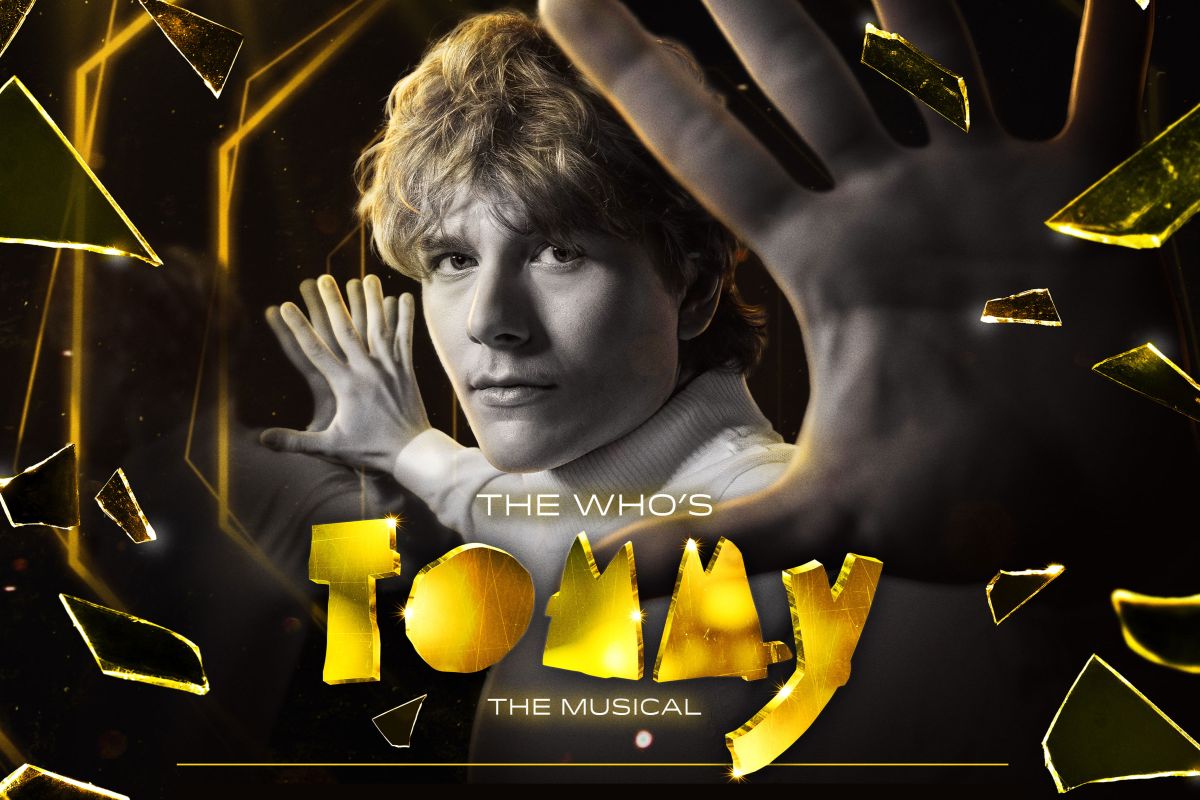
I have said this again and again: I love live theatre above all the other art forms because it comes alive and is experienced on a personal level, in the first person, allowing us to engage all five of our senses. That experience begins in the lobby, with drinks, food and conversation beforehand, and moves into the theatre, where all those senses come together. But what I experienced on opening night of The Who’s Tommy at the McCallum Theatre was unlike anything I had experienced before.
I had not seen Tommy before, but I knew the music. During the first moments of the musical, I was not sure that I would enjoy the show. There was a level of the story that I found disturbing and a reference to my own personal experiences. I was seeing things I did not want to be reminded of, and I was initially left with the impression that this experience was not for me. But those moments begin to give the story the depth it needs to inform the rest of the story—the why and how, and how experiences that are painful can come together to create the basis of a story and why it is being presented in the first place.
We can never get to the end without going through the journey. It is never just about the beginning and the end; it is the journey of discovery and experience on a personal level that cannot be ignored. That is a story well told, one that may have relevance to us and to other members of the audience.
An Amazing Journey Across Generations
The story of Tommy began in 1969 with Pete Townshend and The Who, who introduced the rock opera to the world through a double-record album. Originally conceived by Townshend and record producer Kit Lambert, with contributions from Roger Daltrey, John Entwistle and Keith Moon, the work began its own amazing journey through different forms of artistic expression. Seattle Opera presented a staged production in 1971, followed by an orchestral interpretation with the London Symphony Orchestra in 1972 and Ken Russell’s 1975 motion picture, featuring Roger Daltrey, Ann-Margret, Elton John, Tina Turner and Jack Nicholson, among others.
In 1992, Townshend and director Des McAnuff brought their musical-theatre adaptation to Southern California, where it premiered at La Jolla Playhouse. It opened on Broadway the following year, receiving five Tony Awards. Thirty years later, Townshend and McAnuff returned to the work, reimagining it at Chicago’s Goodman Theatre in 2023 before returning to Broadway in 2024.
Produced by Work Light Productions, the new national tour officially launched at Cleveland’s Playhouse Square on October 6, 2026, and subsequently appeared at the Hollywood Pantages Theatre before arriving at the McCallum Theatre for its November 24–29 engagement. With McAnuff once again directing, it is this latest theatrical interpretation of the work that we have the opportunity to experience here in the Coachella Valley.
A Visual Language of Its Own
What impressed me were the visual graphics, the best I have ever seen in a theatrical production at the McCallum Theatre. The set pieces were simple: a table, a chair, a couch and illuminated door frames that allowed the characters to come and go through the spaces. And then there was the magic mirror, which Tommy is always looking into.
The images were layered one on top of the other, so you were looking at the main background image, which was in constant motion, referencing parts of the story as it moved through the actions onstage, what was going on and how the characters were interacting. While that is the function of placing the actors in their environment, this was different and, in my opinion, brilliant. It added a visual language to the production that allowed us to experience the story on another level as it progressed.
Even without sound or music, it would have been very effective. But then, when you add the vocals, the sung story, the characters and their costumes, and all the movement as the cast has been directed to move by the choreographer, these elements come together to produce an experience unlike one I have experienced before. And I would not be the only one in the audience who was mesmerized by this layered storytelling that works on so many levels at once.
Much of that experience can be attributed to the collaboration between director Des McAnuff, scenic designer David Korins, projection designer Peter Nigrini, lighting designer Amanda Zieve, costume designer Sarafina Bush, sound designer Gareth Owen and choreographer Lorin Latarro. Each has brought a different discipline to the production, yet what we experience is not a collection of separate elements but a single, continuously unfolding work of art.
This is a production that you could see ten times and have a different experience every time, especially if you sat in different places in the auditorium. I would love to have that opportunity if time permitted, although that would probably border on obsession.
I have been involved in theatrical productions and have used projections to help set the scene, and even used a few moving images. I would love to have the opportunity to work with a production crew to help create a work of art on this level. You never know.
Bringing the Characters to Life
Collin Matthew Flanagan takes on the role of Tommy and runs with it from the very moment he is onstage, and that does not stop throughout the production. His performance was exceptional. His movement, his presence and his vocals do the music justice, and he is mesmerizing to watch as he moves about the stage. Considering the demands of the role and the relative youth of this performer, what he accomplishes is all the more impressive.
His younger counterpart, Mari Grossmann, whom I also had the pleasure of meeting, does an exceptional job of portraying the transition from the happy-go-lucky child interacting with his mother, Mrs. Walker, played by Mia Bergstrom, to the young Tommy whose life is so profoundly changed by what he experiences.
Zach Fogel, as Captain Walker, is equally at home playing the role of a father who experiences the frustrations that come with trying to understand and help his son. Together, he and Bergstrom take us through the process of desperately trying to cure young Tommy, repeatedly seeking answers and remedies to no avail, until the story takes another turn.
One of the performers who particularly struck me was Kris Lyons, who plays the Acid Queen. When she was onstage with Tommy and his father, she was mesmerizing. Her voice, performance, movement and presence onstage made me want to see more of her, which I did, although not necessarily in the way one might expect.
As a professional, like so many of the performers in this production, she played her character at an exceptional level and then moved out of the limelight to become a member of the ensemble for the rest of the play. That demonstrates a level of professionalism that is particularly impressive at this early stage in their careers.
Joining these performers are Peyton Cassity as Uncle Ernie, Kyle McFalls as Cousin Kevin and Audrey Fisher as Sally Simpson, along with ensemble members Amaya Adams, Bo Bailey, Tiyanna Gentry, Chase Graham, Trevor “TJay” Groce, Evan Hoefer, Justin Lee-Price and Greyson Taylor, and swings Mariangeli Collado, Josh Devine, Julia Martini and Paul Tuaty. It is the ability of these performers to move between their individual characters and their responsibilities as members of the larger company that makes this production such a remarkable collaborative experience.
And Then There Was the Music
I knew the music of Tommy, and it was performed at the highest level, not necessarily as you might have heard it on a recording, but as a version that had all those elements, performed on a more personal level because it was happening right in front of you. When you add all the other production elements, I had an experience that touched me on an emotional level.
The five musicians responsible for bringing the music to life are Calvin Hitchcock, musical director, conductor and keyboards; Gregory Franz, associate musical director and keyboards; Talia Rose on guitar; Cat Barker on bass; and Kelvin Newell on drums. With musical supervision and additional arrangements by Ron Melrose and original orchestrations by Steve Margoshes, the musicians perform onstage, making the creation of the music itself part of the theatrical experience. In many ways, this brings the production back to its original identity as a live rock performance while retaining the dramatic structure developed by Townshend and McAnuff.
One of my favorite moments of the evening was at the end of the musical, when the entire cast came together onstage to sing that final tribute to the music. The sound was amazing and something I will never forget. When I spoke with Kyle McFalls after the performance, he told me that it was also one of his favorite moments in the musical. Considering the response of the audience and the standing ovation that followed, I suspect we were not alone.
As the cast moved offstage, the musicians were given the stage to themselves, offering us yet another amazing performance as many members of the audience were beginning to exit the theatre. We were reminded of the level of experience and ability these musicians possessed. It was awe-inspiring and something unexpected, a source of sheer pleasure for anyone who had grown up with the music or was listening to it for the first time.
When I spoke with Kelvin Newell, the drummer, at the reception for the performers in the Founders Suite, he told me that they had only recently begun adding this final musical performance to the production. I am glad they did. It gives the musicians their own moment to shine, allowing the audience to see and appreciate one of the most important aspects of the show and the very foundation upon which the telling of this story was built.
Meeting the People Behind the Characters
I love meeting the members of the cast after a performance because it reiterates the level of personal connection that they, as individuals, bring to their characters. And besides, it is great to be around people who are approachable and willing to engage in a conversation, as limited and fleeting as it is in such a situation.
I had the privilege of speaking with a number of the performers, including Collin Matthew Flanagan, Mari Grossmann, Zach Fogel, Kris Lyons, Kyle McFalls and Kelvin Newell. What struck me was the relative youth of much of the company and the level of accomplishment these individuals had already achieved. Kris Lyons told me that she was just two years out of college.
The level of enjoyment, sheer fun and enthusiasm was as apparent to me personally as it was onstage. These members of the company enjoyed what they were doing, and they were excited that someone out of the audience would approach them and tell them how much they had enjoyed their performances. They were all approachable and gracious, and enthusiasm has a way of attracting attention and creating a desire in others to be around those who possess it. That is one of the key ingredients in developing opportunities throughout a career.
I spoke with Kyle McFalls, who told me that he was only twenty, had not completed his formal education and was not a trained dancer. None of that, for me, detracts from what he accomplished onstage. He must have had a level of ability that the casting team recognized because he was called back and put directly into dance rehearsals.
He was learning on the job and, in the end, proved himself to be a full member of the cast, developing a level of expertise that was not just adequate but exceptional. That says something about his own willingness to learn and the level of talent that choreographer Lorin Latarro and her team possess: the ability to guide and coach members of the cast, expand the depth of their abilities and encourage them to perform at a level beyond what they might have seen in themselves.
They saw in him that level of commitment and willingness to continue to learn, something every person in the creative fields must do every day, to constantly improve and, with it, create the opportunity to perform at a higher level and achieve that next opportunity.
That is why creative training is so important, because it empowers individuals to become self-leaders, to envision their futures and make them real, and to do that every day, again and again. It does not matter if they are the highest-paid performers. It is that they choose to envision their own futures and achieve them by their own design.
The Enduring Value of a Story Well Told
I have worked in a majority of the arts throughout my career, including film, but those other forms of art, and any object that is put into concrete physical form, rely on what you bring with you. They act as a touchstone, a very complex touchstone that works on a different level, because the audience or viewer can experience the work individually or with others. That experience is no less powerful, especially when it touches you on some emotional level.
What makes a work like Tommy so interesting is that it has existed in so many different forms. Each of those forms has offered people an opportunity to experience the story in a different way, bringing with them their own experiences and discovering something within the work that has relevance to their own lives.
The value of an artistic experience is not defined solely by its relevancy to any one individual. Its value grows with the number of people it touches on a personal level, in ways that are relevant to them, and that could be any part of the experience. The more authentic the experience and the parts of the story being told, and the willingness on the part of the authors to put that level of personal depth out there to be exposed without knowing the outcome or the response, the greater the opportunity for the work to connect with others and the more universal it becomes.
And when people enjoy that experience around the world, it gains more value. If you then start to add the layers of generations that have experienced the show from its inception, it gains even more value as it moves across time and space on a personal level.
What we are experiencing at the McCallum Theatre is just one more iteration of the telling of a story that began fifty-seven years ago, brought to life through the talent and design expertise that come together to create a whole new experience, not just for me but for anyone who has experienced it in the past.
It is not simply the beginning or the end that matters most, but the journey that this new group of creative individuals takes as they collaborate to create a contemporary telling of the story. That is the enduring strength and value of the story and of all the elements that come together again to tell it.
Come on the Amazing Journey
I thought back to those first moments of the musical, when I was not sure that this was an experience for me, and to everything that had happened between those moments, the extraordinary visual storytelling, the performances, the music, the standing ovation and the time I spent speaking with the performers after the show. Had I not been willing to experience those first uncomfortable moments, I would never have had the opportunity to experience everything that followed.
That was my journey, and every other member of the audience had the opportunity to experience a journey of their own. My personal experience of the performance is ultimately relevant to me, with the exception that I would encourage others to see this production of Tommy, no matter where it might be presented. Because there is an opportunity for them to have their own personal experience and perhaps discover something of that universal experience I have been speaking about.
Come on the amazing journey, discover what it might mean to you, and, quite simply, enjoy yourself.
The Who’s Tommy — The Musical
McCallum Theatre
73000 Fred Waring Drive
Palm Desert, California 92260
November 24–29, 2026
Remaining performances:
- Friday, November 27 — 2 p.m. and 8 p.m.
- Saturday, November 28 — 2 p.m. and 8 p.m.
- Sunday, November 29 — 1 p.m. and 6:30 p.m.
Tickets: Starting at $64, subject to availability.
Running time: 100 minutes without intermission.
Recommended audience: Ages 16 and older.
Production advisory: The production contains mature subject matter, loud music, gunshots, theatrical haze, strobe and flashing lighting effects.
Box office: (760) 340-2787
Toll-free: (866) 889-2787
Performance information and tickets: McCallum Theatre — The Who’s Tommy
Additional production information: Official Tommy Touring Cast and Creative Team — Production Credits and Professional Biographies
Official production photography: Evan Zimmerman for MurphyMade.
About the Author
Marty Treinen is the co-founder of Universal Creative Intelligence LLC and the co-creator of Universal Creative Intelligence™ (UCI), a groundbreaking framework that teaches people of all ages the creative, emotional, and cognitive skills needed for lifelong success. An artrepreneur, arts/museum educator, and project leader, Marty draws on a decades-long career spanning fine arts, theater, film, design, and museum education.
They are currently developing the Introduction To Universal Human Intelligence Education ™ programs for individuals, students, educators, colleges and universities.
Their mission is simple: equip people with the creative intelligence to build the future they envision for themselves. Universal Leadership Education™ will give them self leadership abilities.
As a columnist for The Palm Springs Tribune, Marty covers theater, film, visual and performing arts, human-centric AI, arts education and cultural events throughout the Coachella Valley. His reviews are known for their honesty, authenticity, clarity, and deep respect for the power of the arts and creative intelligence, to enhance our lives.
© Marty Treinen 2026 All Rights Reserved