


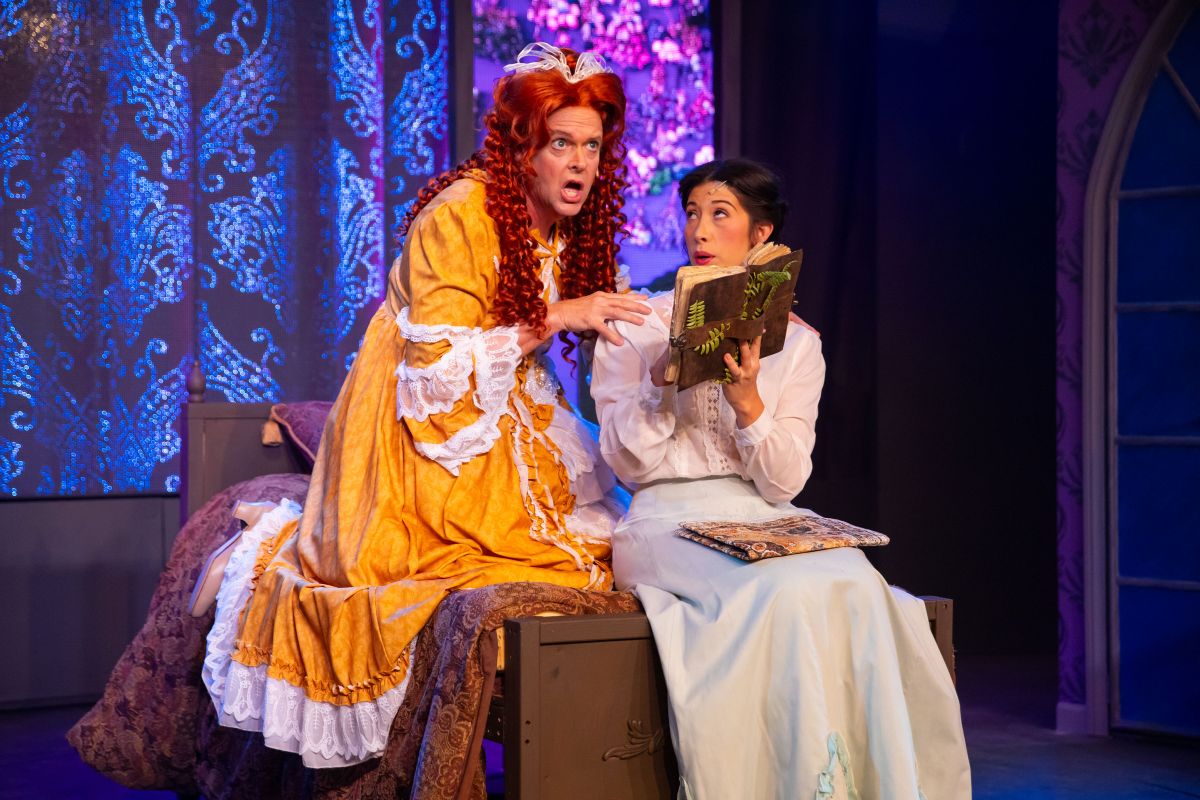
I am a huge fan of The Carol Burnett Show and Halloween. If the two of them had a baby, I suspect you would end up with Dracula: A Comedy of Terrors, now playing at Revolution Stage Company in Palm Springs. Written by Gordon Greenberg and Steve Rosen, the show pulls together the best of Dracula lore and spins it on its head, creating an evening of outrageous characters, ridiculous situations, and enough sexual innuendo to make even a seasoned vampire blush. It reminded me of those wonderful Carol Burnett sketches, where you knew perfectly well that something naughty was going on, even when nobody was quite willing to admit it.
Comedy is a lot like sex. It’s hard to describe. Either it was good for you or it wasn’t. Sometimes it was good for them and not for you, sometimes it wasn’t particularly good for either of you, and occasionally it was so exceptional for everybody involved that you can’t wait to do it again. Expectations often set the stage, and experience, or sometimes the lack of it, can determine how satisfying the outcome will be. There is a certain logic to all of this, although I suspect most of us have discovered that logic doesn’t always have much to do with either comedy or sex. Sometimes the best thing you can do is leave your expectations at the door and see what happens.
I remember watching Carol Burnett, Harvey Korman, Tim Conway, and Vicki Lawrence and realizing that much of their comedy depended on the suggestion of something happening just beneath the surface. Sometimes it was an innocent remark with a not-so-innocent meaning, sometimes it was a look, and sometimes it was simply the suggestion of sexual desire that everyone understood but nobody needed to explain. And just as important, every one of those actors understood their position. Somebody had to be on top of the joke, somebody had to be on the bottom, and everybody had to know when it was time to change places. If you think about it, that’s a pretty good description of successful comedy, and perhaps a few other things as well.
That is exactly what makes Dracula: A Comedy of Terrors work. It is easy for spoof comedies to become tiresome when the jokes keep coming without giving the audience an opportunity to enjoy them. Director Nathan Wilson understands that comedy requires pacing, anticipation, and, perhaps most importantly, knowing when to deliver the goods. He keeps the production moving at an impressive pace but knows how to milk a joke for everything it’s worth without wearing it out. The opening carriage ride is a wonderful example, establishing the absurdity of what is about to happen and getting the audience ready for a very enjoyable evening. From that point forward, it becomes a question of who is going to do what to whom, and how much fun the rest of us are going to have watching.
The core cast of Adam Hieter, Rebecca McWilliams, Jackson Tropp, and Danielle Vargas jumps in and out of characters with remarkable ease. But the real achievement is how they work together. Some comedic actors are required to be at the bottom of the joke, others at the top, and what makes this production so enjoyable is that everyone gets to take a turn. One actor sets up the situation, another takes advantage of it, and before you know it, they have changed positions entirely. Nobody is afraid of looking foolish, and nobody seems particularly concerned about who is getting the biggest laugh, because the next opportunity is usually just around the corner. They understand that it takes cooperation to make the entire experience satisfying, and all four do it exceptionally well.
Hieter’s Mina was a particular favorite of mine. There is something wonderful about watching an actor commit completely to a character who is so delightfully ridiculous. Hieter understands that the character must remain absolutely convinced of what is happening, even when everyone in the audience knows that the whole thing is absurd. McWilliams, Tropp, and Vargas are equally important to the pleasure of the evening, moving through their various characters and situations without losing the rhythm of the comedy. There is a great deal going on, and it would be easy for someone to miss an entrance, a reaction, or an opportunity. But everyone knows their part, their position, and when it is time to let somebody else take over.
And then there is Sean Timothy Brown as Dracula. Brown plays a very sexy Dracula, and let’s be perfectly clear, there is nothing wrong with that. But his comic timing demonstrates that he is much more than a sexy accessory to the show. He knows how to use his appearance to his advantage, but he also knows when to allow himself to become the object of the joke. Being desirable is one thing; being funny while everyone else is trying to get their hands on you is something else entirely. Brown manages both, and judging from the audience’s response, nobody seemed particularly disappointed.
What I enjoyed most about the production is that everyone, including the audience, seems to understand the game being played. Some of the jokes are obvious, others sneak up on you, and occasionally you realize that something has happened and you missed the whole thing. But that’s part of the experience. Comedy requires participation, even when the audience is simply sitting there watching. The actors can do everything right, but if the audience isn’t engaged, it’s a little like bad porn. Everybody seems to be having a wonderful time except the people watching, and you eventually start wondering why you bothered in the first place. Fortunately, that is not the case here. The audience was very much in on the joke, and the laughter became part of the performance.
Of course, there is another important element to successful comedy, and that is knowing when to climax. You can build anticipation, change positions, introduce new possibilities, and keep everybody wondering what’s coming next, but eventually somebody has to deliver. And when the timing is right, the entire experience comes together. That is something Wilson and his company understand very well. The production never seems to lose sight of the fact that the goal is to entertain the audience, not leave them sitting there wondering what went wrong. We didn’t come to the theater to work that hard. We came to have a good time, and sometimes that is more than enough.
My husband Wesley and I certainly had a very good time, and from the laughter around us, I would say the rest of the audience did as well. Sometimes we caught every joke, sometimes we probably missed a few, and there were undoubtedly moments when somebody else was getting considerably more out of the experience than we were. But that’s comedy. Not everybody is stimulated by the same thing, and that is probably a very good thing. What matters is that the performers understood what they were doing, the audience was willing to participate, and by the end of the evening, everyone seemed to have gotten what they came for.
So, if you are looking for something to do during Spooky Season, leave your good and bad experiences with vampires, Dracula, and perhaps a few other things behind, and take a chance on Dracula: A Comedy of Terrors. Comedy, like sex, is one of those experiences that is almost impossible to explain adequately once it’s over. Either you had fun or you didn’t, either you want to do it again or you don’t, and sometimes you simply smile and decide it was well worth the effort. Wesley and I left the theater very satisfied. We can’t guarantee that you will have quite the same experience, but you won’t know unless you’re willing to play. And who knows? You might come out just as satisfied as we were.
Theater Information
Production: Dracula: A Comedy of Terrors
Playwrights: Gordon Greenberg and Steve Rosen
Director: Nathan Wilson
Theater: Revolution Stage Company
Address: 611 S. Palm Canyon Drive, Palm Springs, CA 92264
Dates: October 15–November 1, 2026, according to the production’s ticket page
Running time: Approximately 90 minutes
Tickets and performance schedule: Revolution Stage Company or official ticketing page
Box office: 760-318-4115
About the Author
Marty Treinen is the co-founder of Universal Creative Intelligence LLC and the co-creator of Universal Creative Intelligence™ (UCI), a groundbreaking framework that teaches people of all ages the creative, emotional, and cognitive skills needed for lifelong success. An artrepreneur, arts/museum educator, and project leader, Marty draws on a decades-long career spanning fine arts, theater, film, design, and museum education.
They are currently developing Introduction to Universal Leadership Education programs for individuals, students, educators, colleges and universities.
Their mission is simple: equip people with the creative intelligence to build the future they envision for themselves. Universal Leadership Education will give them self leadership abilities. If you can’t lead yourself, how are you going to lead others?
As a columnist for The Palm Springs Tribune, Marty covers theater, film, visual and performing arts, human-centric AI, arts education and cultural events throughout the Coachella Valley. His reviews are known for their honesty, authenticity, clarity, and deep respect for the power of the arts, to enhance our lives.
© Marty Treinen 2026 All Rights Reserved
service.to.others.cci@gmail.com