


Indio, CA
George Washington probably never imagined that his dentures might someday become the last hope of a struggling historical museum, but that is precisely the predicament facing a determined group of women in Mark St. Germain’s George Washington’s Teeth. Desert Theatreworks brings this unlikely comedy to the stage in Indio from October 16 through October 25, introducing audiences to the women of the New Bunion Historical Society, who are desperately trying to save their small, tired museum. Their institution has clearly seen better days, and there seems to be little they can do to keep it alive. That is until a set of dentures purported to have belonged to the nation’s first president unexpectedly appears, offering the possibility that a rather unusual piece of American history might be just what they need to save their beloved institution.
What follows is a wonderfully improbable collection of situations, eccentric personalities, and comic complications as the women attempt to make the most of their discovery. St. Germain has written what appears, at first, to be a rather wacky comedy, complete with broadly drawn characters and jokes that range from genuinely clever to the sort of humor that would make any father proud. There is certainly nothing wrong with a good dad joke, particularly when it is delivered by someone who knows exactly how to make it work. Yet beneath all the foolishness, the playwright has something more substantial in mind. The museum may be filled with artifacts from the past, but the question of whose history gets remembered, and whose contributions have been overlooked, gives the story a relevance that extends beyond the laughter.
That larger question becomes particularly important with the appearance of Louisa Tye, played by Collette “Coco” Maria Owens. Louisa reminds us that the history we have inherited is not necessarily the whole story, especially when we consider the contributions of African Americans, women, and others whose experiences have not always received the recognition they deserve. Owens brings a vitality to the second portion of the production that is immediately apparent, brightening the stage with her presence and giving the story a welcome burst of energy. Her performance also helps bring the play’s more thoughtful observations into focus without losing the comic spirit that carries the evening. It is a welcome addition to a production that, by this point, begins to encounter some difficulties with the playwright’s storytelling.
Those difficulties are most apparent in the second act, where a considerable amount of the action takes place offstage. Instead of allowing the audience to experience some of the developments firsthand, the script leaves the characters to tell us what has happened, interrupting some of the momentum established earlier in the evening. Director Hal O’Connell faces the challenge of keeping the comedy moving while working around these structural limitations. For the most part, he succeeds, relying on the strength of his ensemble and an understanding that a comedy of this kind depends as much on the relationships between the characters as it does on the jokes themselves. His direction keeps the production lively and gives the actors room to develop their characters, even when the writing does not always provide them with everything they might need.
Fortunately, O’Connell has assembled a cast that includes some of the area’s experienced community theater comedy performers, and their understanding of comic timing makes an enormous difference. Janae Kelban, as Hester Bunion, leads the ensemble with a confident command of the stage, providing a strong center around which the other characters can operate. Margo Blessing, playing Edie Plotz, provides much of the comic relief and demonstrates a particular talent for making even the most obvious jokes work. She understands that comedy is often less about the joke itself than about how it is delivered, and she finds the right moments to let a line land. Together, Kelban and Blessing help establish the rhythm of the production, giving their fellow performers a dependable foundation from which to explore the increasingly ridiculous circumstances surrounding the museum’s discovery.
One of the most interesting performances comes from Alexana Thomas as Ann Mather, who has the unenviable assignment of being the straight woman in a room filled with decidedly wackier characters. It is a role that can easily be overlooked, particularly when other performers are getting the biggest laughs, but Thomas understands its importance. There is something of Bea Arthur in her approach to comedy, a dry precision that allows a simple look or perfectly measured response to be every bit as effective as a punch line. In many ways, she is one of the unsung heroes of the ensemble, providing the balance that allows the other characters to be as outrageous as they are. Char Hecht, as Jess Wider, brings a younger perspective to the proceedings and manages to give some welcome dimension to a character that is written a little flat. She finds enough personality in Jess to make her a meaningful part of the group, rather than simply the younger woman among her more experienced companions.
The ensemble is completed by Stan Jensen, whose voice performances as an announcer, DJ, and mayor contribute to the collection of personalities that inhabit the world of New Bunion. The cast works well together, and there is considerable pleasure in watching experienced comic performers build on one another’s work. Even when the material becomes predictable, their timing, reactions, and willingness to share the stage keep the comedy entertaining. It is an important distinction, because the success of this production rests not simply on the cleverness of the script, but on the ability of the actors to make its characters believable within an otherwise unbelievable situation.
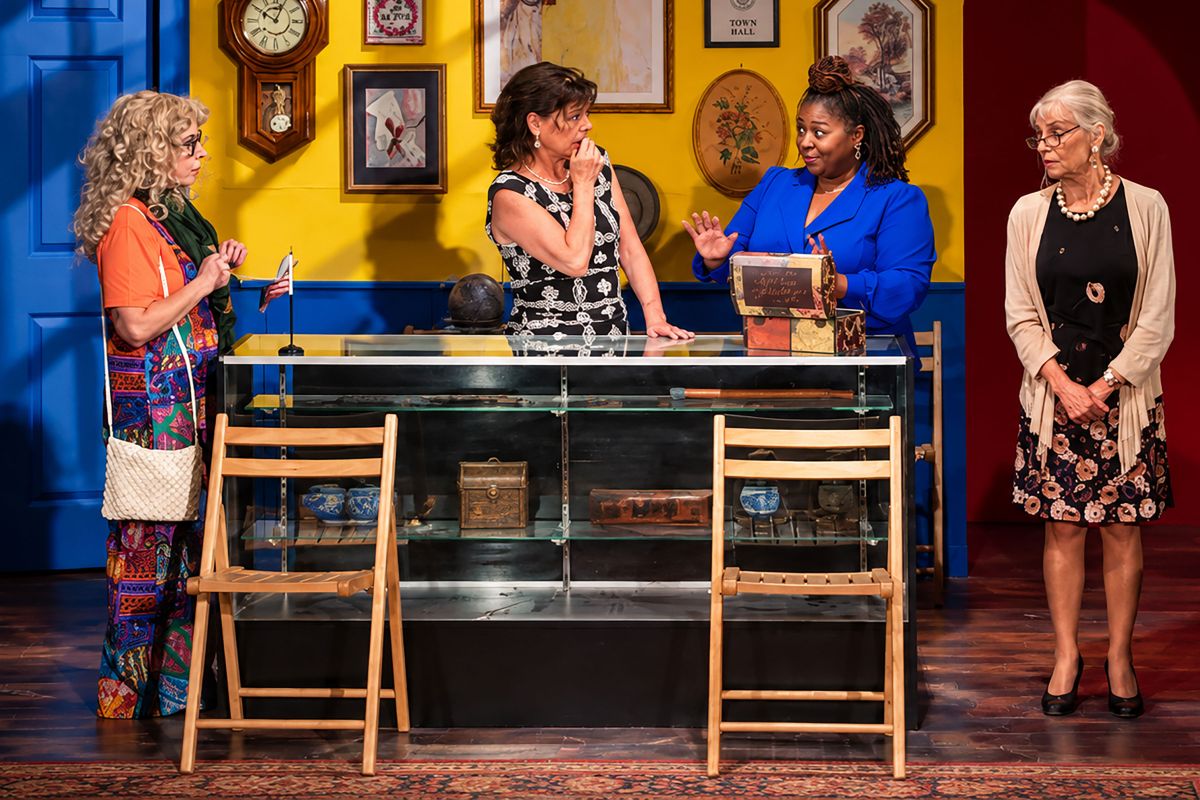
The physical production contributes a great deal to that sense of place. The museum itself is an interesting and carefully detailed environment, filled with furnishings, set dressings, and amusing props that suggest an institution that has accumulated a considerable amount of history without necessarily acquiring the resources to maintain it. There is something rather appropriate about that appearance, given the society’s predicament, and the set provides an effective home for the story. The costumes complement the individual personalities without competing for attention, while the lighting and sound support the comic details and keep the focus where it belongs. Taken together, these elements help create a believable setting for a group of women whose devotion to their museum is as genuine as their methods for saving it are questionable.
What makes George Washington’s Teeth such an enjoyable evening of theater is the ability of O’Connell and his ensemble to take a script with some structural challenges and turn it into a lively, entertaining production filled with humor and personality. The second act may occasionally struggle to maintain the momentum of the first, but the strength of the performances, the chemistry among the actors, and the sheer pleasure of watching these eccentric characters navigate their increasingly improbable circumstances keep the audience engaged. There are plenty of laughs along the way, and perhaps that is the most important thing to remember about an evening at the theater. We come to be entertained, to share an experience with others, and occasionally to discover something we had not considered before. This production accomplishes those things, offering an enjoyable evening while reminding us that history is never quite as simple as the objects we put on display. Sometimes what matters most is not what we have preserved, but what we have forgotten.
Desert Theatreworks continues its season with a lineup that offers audiences plenty of reasons to return to Indio. November brings Sister Act, featuring Kornbread of RuPaul’s Drag Race fame, followed by Peter Pan Goes Wrong in December, Steel Magnolias in January, Clue in February, and Dolly Parton’s 9 to 5 in March and April. With a season offering everything from broad comedy to familiar theatrical favorites, the company has assembled a schedule that should make the drive to Indio well worth considering.
About the Author
Marty Treinen is the co-founder of Universal Creative Intelligence LLC and the co-creator of Universal Creative Intelligence™ (UCI), a groundbreaking framework that teaches people of all ages the creative, emotional, and cognitive skills needed for lifelong success. An artrepreneur, arts/museum educator, and project leader, Marty draws on a decades-long career spanning fine arts, theater, film, design, and museum education.
They are currently developing Introduction to Universal Leadership Education programs for individuals, students, educators, colleges and universities.
Their mission is simple: equip people with the creative intelligence to build the future they envision for themselves. Universal Leadership Education will give them self leadership abilities. If you can’t lead yourself, how are you going to lead others?
As a columnist for The Palm Springs Tribune, Marty covers theater, film, visual and performing arts, human-centric AI, arts education and cultural events throughout the Coachella Valley. His reviews are known for their honesty, authenticity, clarity, and deep respect for the power of the arts, to enhance our lives.
© Marty Treinen 2026 All Rights Reserved
service.to.others.cci@gmail.com