

Palm Springs, California
Palm Springs has no shortage of Pride celebrations, gay events, leather gatherings, and opportunities for people to come together. But there is something different happening at Jaco Moretti Arts, a gallery on East Sunny Dunes Road. Jaco has brought together two exhibitions connected with Leather Pride and Palm Springs Pride, providing an opportunity to encounter artwork exploring gay male culture, identity, personal relationships, and the many ways people choose to present themselves to the world. These exhibitions made me think about something much larger than the artwork itself: who gets to be seen, how we interpret the images of other people through our own experiences and personal perspectives, and why it matters that artists, across the spectrum, have opportunities to present their work publicly.
The Leather Pride exhibition preceded the current Pride presentation, and although only some of its artwork remains on display, I think it deserves particular attention. The leather community represents a distinct and self-identified group of individuals, with its own traditions, relationships, symbols, and ways of presenting themselves. The images include men of different racial and cultural backgrounds, some bearded, some muscular, dressed in leather, masks, and clothing associated with leather culture. There are expressions of masculinity, confidence, sexuality, and sometimes the symbols of dominance, submission, and sadomasochism. To someone unfamiliar with the community, these images may appear provocative, intimidating, or uncomfortable. To someone who participates in that culture, the same images may be immediately recognizable as expressions of identity, personal relationships, and belonging.
But there is something more complex here, and it is certainly not limited to leather culture. Most of us have different identities that we present in different circumstances. We dress, behave, and communicate according to the people around us, the professions we practice, the organizations we belong to, and the communities with which we identify. Sometimes those identities are compatible, and sometimes they are not. We may be comfortable expressing one part of ourselves among friends while concealing it from our families, employers, religious communities, or even other social groups. In that respect, the leather community is no different from the rest of society, except that some aspects of its culture have historically remained unseen or misunderstood, including within the larger LGBTQ+ community.
What interests me is how people manage these different identities, particularly when one part of their lives is considered unacceptable by a dominant culture. That pressure can force individuals to conceal something important about themselves, making it more difficult to find others with whom they share experiences, relationships, and a sense of community. In some circumstances, the very people who might benefit most from knowing that a community exists have limited opportunities to discover it. That is one of the reasons public visibility matters. It allows individuals to see representations of people and experiences that might otherwise remain inaccessible to them.
We have communities built around almost every conceivable interest, profession, cultural tradition, and human activity. People gather in clubs, associations, religious organizations, professional conferences, artistic movements, and social events. Each develops its own language, symbols, customs, clothing, images, and ways of communicating. What is familiar within one community may be entirely foreign to another. An art gallery offers something that many other settings do not: the opportunity to encounter another person’s world without being required to participate in it.
And that, to me, is what makes Jaco’s Pride exhibitions important. The artwork is specific to its subject, but the experience of viewing it is not limited to the community being represented. People unfamiliar with gay culture may discover something unexpected. Others may recognize friends, relationships, personal experiences, or parts of themselves that they rarely see publicly represented. Still others may find the images uncomfortable, unimportant, or objectionable and choose to move on. Each response belongs to the individual viewer, who brings a lifetime of experiences, beliefs, memories, and personal judgments to what they see.
The artist decides what to create and what to share, but cannot determine everything another person will see, understand, or remember. I have always found it troubling when someone attempts to define the value of art for everyone else, particularly when those judgments are accepted simply because they reflect the perspective of a dominant culture. No one has the right to determine the value of another person’s identity, how they choose to live, or how they wish to represent themselves. We can make those decisions for ourselves, but we cannot make them for everyone else. And sometimes an image that means nothing to us today may become important years later, when another experience produces that unexpected moment of recognition or understanding.
Jaco Moretti: Making Artists’ Voices Visible
Jaco Moretti is himself a photographer, and understanding his artwork helps explain the direction of his gallery. His photographs explore the male figure, friendships, intimacy, desire, and relationships among men, often in places with established gay communities, including Palm Springs, Fire Island, Provincetown, and New York City. His work celebrates physical beauty and the freedom to be oneself while recognizing experiences of loneliness, isolation, and loss. His photographs are not simply pictures of men. They represent his perspective on the people, places, and relationships that give those images meaning.
What particularly interests me about Jaco’s photography is the relationship between the male figure and the architectural and natural environments in which his images are created. Palm Springs is recognized around the world for its architecture, swimming pools, palm trees, mountains, and extraordinary desert setting. These are not simply backgrounds for his photographs. They are part of the experience of living here, especially for gay men who have established friendships, relationships, and communities within those spaces. His photographs place the human figure within that environment, sometimes nude, sometimes alone, sometimes with others, and frequently in settings that suggest familiarity, comfort, and freedom.
There is also something important about the architectural history of Palm Springs. Its buildings and landscapes have appeared in decades of photographs, films, publications, and advertisements, becoming part of the city’s visual identity. Those images often reflected a particular view of the people who lived and vacationed here. By placing gay men and their relationships within these familiar settings, Jaco adds another perspective to the way Palm Springs is represented and remembered. His photographs do not replace the images that came before them. They expand the visual history of the city by including experiences and relationships that have not always been represented so openly.
Jaco began publicly exhibiting his photography in 2018, published his first photography book, Palm Springs, in 2024, and opened Jaco Moretti Arts in November of that year. In a relatively short period, he has brought together artists working in photography, drawing, painting, and sculpture, each with an individual approach to the human figure and gay male experience. That variety is important because there is no single way to represent a community. Each artist brings something different, shaped by education, culture, personal experience, and the circumstances of their lives.
I have been thinking about how best to describe Jaco’s contribution, and I keep coming back to one observation: Jaco doesn’t give artists a voice. He makes their voices visible. Artists already have their own voices, developed through education, observation, imagination, relationships, and years of creating their work. What Jaco provides is an opportunity for those voices to occupy a public space, to be seen by people within their own communities, by the larger gay community, and by individuals who might never otherwise encounter them. The importance is not simply the opportunity to exhibit artwork, but the possibility that the artwork will reach an audience far beyond the people and experiences it originally represents.
The Artists and Their Individual Perspectives
Two artists whose work and published interviews help explain this relationship between artist and audience are Miguel Angel Reyes and Kory Alexander. Their approaches are quite different, but both demonstrate how personal experience influences the creation of artwork and how the human figure can communicate something beyond its immediate physical appearance.
Miguel Angel Reyes, a Mexican-born artist based in Los Angeles, graduated from Otis/Parsons in 1987 and has developed an extensive career encompassing portraiture, figurative painting, illustration, photography, printmaking, and public murals. He has also taught at Otis College of Art and Design, bringing his professional knowledge and experience into the education of other artists. His work frequently explores the human figure through expressive color, movement, personality, and relationships. Although some of his work is erotic, reducing his paintings and drawings to sexuality alone would overlook much of what he is communicating.
In a 2014 interview published in The Fight, Reyes described the relationship between the artist and the people he portrays, explaining, “The drawing session is an intimate situation where the models reveal themselves physically and sometimes emotionally.” I find that particularly revealing because it recognizes that the artwork is not simply the product of an artist looking at another person. It comes from an interaction in which the individual being portrayed contributes something of themselves, both physically and personally. The artist interprets that encounter, making decisions about what to emphasize, what to leave out, and how to communicate the personality of the person before them.
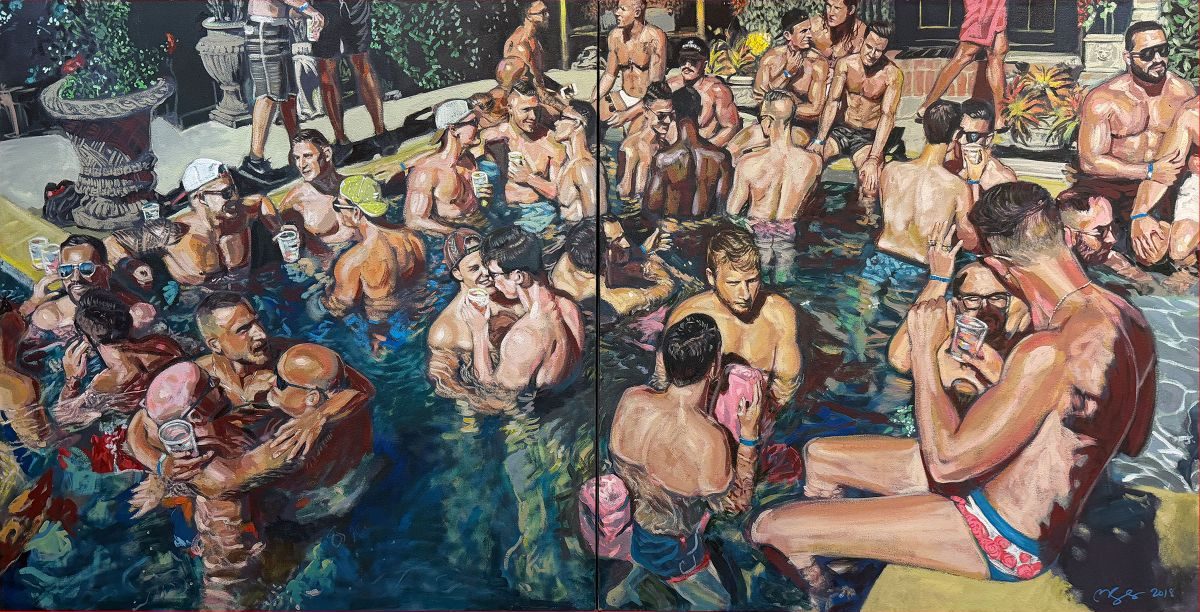
Reyes has also photographed gay pool parties in Los Angeles, with extensive photographic coverage appearing in publications including The Advocate and Out. Two pool paintings in Jaco’s exhibition connect with this photographic practice, bringing scenes of gay social life into another artistic medium. The images focus on individuals gathered around swimming pools, representing the diversity of people, relationships, and experiences found within these communities. What might initially have been seen as photographs documenting a particular social gathering becomes something different when interpreted through painting and presented in a gallery. The people and circumstances remain connected to the original experience, but the artwork can now reach an entirely different audience.
[Photograph placement: One of Miguel Angel Reyes’s two pool paintings in the exhibition. Final title, date, medium, dimensions, and image credit to be confirmed.]
Kory Alexander approaches painting from another direction. Born in Maryland and educated at the University of Texas at Dallas, Alexander now works in Los Angeles, creating paintings that frequently combine human figures with California landscapes, swimming pools, architecture, and moments of intimacy. His work is influenced by memory, personal relationships, light, color, and atmosphere. In a 2023 interview with Shoutout LA, he explained, “I mainly take inspiration from my personal life and my favorite memories.” His exhibition history includes The Pride Show at Jaco Moretti Arts in November 2025 and the gallery’s Summer Salon in May 2026.
Alexander’s paintings are particularly interesting because they do not necessarily tell the viewer everything about the people or events they represent. A figure beside a swimming pool, two people together, or a landscape illuminated by sunlight or artificial light can mean something deeply personal to the artist while inviting entirely different memories from someone viewing it. That difference is not a weakness in communication. It is one of the artwork’s strengths. The viewer brings experiences that the artist may never have known, and the relationship between the artwork and its audience continues to develop.
There is another connection between these artists that I find especially interesting, and that is water. Swimming pools appear throughout Jaco’s photographs, Reyes’s photographic and painted images, and Alexander’s paintings. Water is one of the most familiar and universal elements of human experience, yet our relationships with it are extraordinarily varied. It may be a swimming pool, bathtub, river, lake, ocean, or something as simple as a place where we gather with others. Across cultures, water has been represented in every conceivable form of art, carrying associations with recreation, survival, cleansing, ritual, intimacy, pleasure, solitude, and even danger. Its meanings are as varied as the people who experience it.
Alexander has described his particular fascination with the changing appearance of water, explaining in his artist statement that “The idea of ‘painting light’ when it comes to water is the most intriguing thing to me.” His paintings explore the effects of light, atmosphere, reflections, and color, often drawing upon childhood memories of swimming and the California landscape. Yet the presence of the human figure introduces another dimension. The water becomes more than a visual subject. It becomes an environment in which people interact, experience physical sensations, and establish personal relationships with their surroundings.
Water creates circumstances that are different from many ordinary social settings. People may remove their clothing, enter an environment where the body is exposed, and experience their surroundings in ways that involve nearly all their senses. A swimming pool can be a place of solitude, recreation, friendship, intimacy, or simply an opportunity to escape the desert heat. What those experiences mean to the people involved is something only they can fully understand. The artists take those encounters and interpret them through their individual creative practices, allowing the rest of us to see something of their perspectives.
What I find especially revealing is that three artists can work with similar subjects, including the male figure, water, and architectural environments, and produce artwork that communicates entirely different experiences. Reyes may begin with the people and relationships he has photographed at an actual gathering. Alexander may draw upon memories and imagined moments, interpreting the effects of light and atmosphere through painting. Jaco may bring the figure into a recognizable Palm Springs environment, connecting the person with a particular place and its cultural identity. Each creates something individual, even when the subjects appear familiar.
These differences also remind us that a career in the arts is not simply about producing attractive images. It requires education, observation, technical ability, experimentation, failure, discovery, and continuous development. Their artistic styles emerge from years of looking at the world and deciding how they want to interpret it. Jaco’s gallery brings these different forms of human creativity into contact with audiences, allowing visitors to encounter work that may be familiar, unfamiliar, challenging, or personally meaningful.
Who Is Represented, and Who Is Looking?
I recognize that Jaco’s gallery has a particular focus. Its emphasis is gay male life, and these exhibitions include communities and visual traditions that have not always received sympathetic public representation. I could ask why there is not more artwork representing women’s love or other aspects of LGBTQ+ experience, but every gallery develops a mission, just as every artist selects a subject. The important question is not whether one gallery can represent everyone. It is whether the people and experiences it chooses to present are treated with artistic seriousness and given an opportunity to be encountered.
I also think we sometimes overlook what happens when artwork moves beyond the community from which it originated. The images may represent particular people, relationships, and experiences, but their importance does not end with those who recognize themselves in them. Once the work becomes publicly available, its audience may expand considerably, potentially reaching thousands or millions of people through exhibitions, publications, photography, and other forms of communication. Each viewer brings a different history and perspective. What was once familiar to a relatively small group can become part of a much larger conversation.
I think of this as expanding the mirror. We are accustomed to seeing ourselves reflected in familiar images, but art also provides an opportunity to see beyond ourselves. It allows us to encounter people whose lives may be entirely different from our own, while sometimes discovering unexpected similarities. A painting or photograph may be created from one person’s experience, but its meaning can expand through the experiences of others. The artist cannot know everyone who will encounter the work or predict how those encounters may change someone’s understanding.
That is also why I place so much importance on experiencing original artwork in person. An image on a telephone or computer screen can communicate a great deal, and digital technology makes artwork accessible to audiences who might otherwise never see it. But it does not reproduce the complete physical experience of standing before an original work. Scale, surface, texture, materials, physical presence, and the environment in which an artwork is displayed influence how we perceive it. Sometimes the most important discovery comes from something we did not notice at first, or from a conversation with the artist or another visitor that changes how we look at the work.
The importance of this relationship continues when artwork is purchased and becomes part of someone’s personal surroundings. A painting, photograph, or sculpture may become a constant visible reminder of a relationship, experience, identity, or period in someone’s life. It occupies a place in their home and becomes part of their personal environment, often acquiring additional meaning over time. Almost any object can carry memories, but artwork has a particular capacity to bring together the artist’s experience with that of the person who chooses to live with it. Collectors also become part of the process of preserving original works and making it possible for future generations to encounter them.
Art, Memory, and the Lives That Came Before Us
There is another connection I want to make because I have been working on a separate review of the Spanish film La bola negra (The Black Ball), directed by Javier Calvo and Javier Ambrossi. The film draws inspiration from four surviving pages of an unfinished play by Federico García Lorca, who was murdered in 1936. It brings together the experiences of gay men across different periods of Spanish history, exploring love, exclusion, secrecy, and the consequences of being denied the opportunity to live openly. Although the film and Jaco’s exhibitions are very different forms of art, they share something important: the opportunity to make experiences visible that previous generations often had to conceal.
The title itself has historical meaning. A black ball could be used in a membership vote to reject an individual from an organization or club. It is a small physical object with an enormous implication: the power of one group to decide that another person does not belong. When I think about that object in relationship to Jaco’s gallery, the contrast is striking. One represents exclusion. The other provides a place for people and their experiences to become visible. Both demonstrate how physical objects, images, and symbols can carry meanings that extend far beyond their original circumstances.
In an October 2026 interview published by Film Updates, Ambrossi explained, “All your memories will disappear when you die, but objects will stay.” Calvo added, “Art is the thing that we inherit.” Those observations connect directly with something I have been developing for years: the importance of Physical, Material, and Concrete Memory, or PM&CM. Objects, manuscripts, paintings, photographs, architecture, films, and other things created by human beings preserve evidence of our lives and experiences. Their original forms matter, as do the historical records and documentation that help us understand the people and circumstances surrounding their creation.
Digital technologies are valuable tools for preserving records, transferring information, and introducing artwork to audiences around the world, but they cannot replace the original physical objects or the complete experience of encountering them in person. Through our senses, we establish relationships with objects, places, and other people that become part of our own memories and understanding. As long as these physical records survive, new generations have opportunities to experience them directly, whether in solitude or through the shared experience of visiting a museum, gallery, historic building, or cultural site.
I believe this continuing exchange is fundamental to human intelligence and creativity. Artificial intelligence can be useful for researching, organizing, translating, and communicating information, but it cannot replace the original objects or the lived human experiences that brought them into existence. Nor should the ability to generate information be mistaken for the continuing human process of learning from other people, questioning what we think we know, developing new perspectives, and creating something through our own experiences. These are processes that have developed throughout human history, connecting people, cultures, objects, and events across generations.
The connection between Jaco’s exhibitions and La bola negra is not simply that both address gay experiences. It is that each demonstrates how artwork can bring individual lives into a larger human history. Four surviving pages of a manuscript can inspire a film that reaches audiences across the world. A photograph taken at a pool party can become a painting, enter an exhibition, and eventually become part of someone’s personal collection. The original experiences remain connected to the works, but new relationships and interpretations develop as the artwork moves through the world. And those connections may continue long after the people who created the work are gone.
That brings me back to Jaco Moretti Arts. The value of his Pride exhibitions is not simply that they display images of gay men, leather culture, and personal relationships. It is that Jaco has created a place where artists can share their perspectives, where the public can encounter those perspectives directly, and where the stories represented by the artwork can continue to expand beyond the intentions of their creators. Not everyone who enters the gallery will see the same thing, and they shouldn’t have to. What matters is that they have the opportunity to see, to think, to question, and perhaps to understand something they did not understand before.
For me, that is the continuing importance of the arts, and why the opportunities Jaco provides matter. A gallery may occupy a relatively small physical space, but the experiences it makes possible can extend through people’s lives, relationships, memories, and conversations long after they have left the building. Through exhibiting and selling artwork, Jaco helps expand its audience while providing opportunities for individuals to acquire and preserve works that are personally meaningful to them. The artwork becomes part of their surroundings, their experiences, and potentially the memories they pass along to others.
Jaco doesn’t give artists a voice. He makes their voices visible. And by doing so, he gives the rest of us an opportunity to discover what those voices have to say.
About the Author
Marty Treinen is the co-founder of Universal Creative Intelligence LLC and the co-creator of Universal Creative Intelligence™ (UCI), a groundbreaking framework that teaches people of all ages the creative, emotional, a
nd cognitive skills needed for lifelong success. An artrepreneur, arts/museum educator, and project leader, Marty draws on a decades-long career spanning fine arts, theater, film, design, and museum education.
They are currently creating Out Of My Darkness – Into Our Light. A biographical portfolio of visual arts and sculpture; covering Marty’s 50 years of experiences, by an artist that just happens to be gay.
Their mission is simple: equip people with the creative intelligence to build the future they envision for themselves. Universal Leadership Education™ will give them self leadership abilities. As a columnist for The Palm Springs Tribune, Marty covers theater, film, visual and performing arts, human-centric AI, arts education and cultural events throughout the Coachella Valley. His reviews are known for their honesty, authenticity, clarity, and deep respect for the power of the arts, to enhance our lives.
© Marty Treinen 2026 All Rights Reserved
Jaco Moretti Arts\
577 East Sunny Dunes Road, Palm Springs, California
Information on when the gallery is open, contact Jaco Moretti Arts