

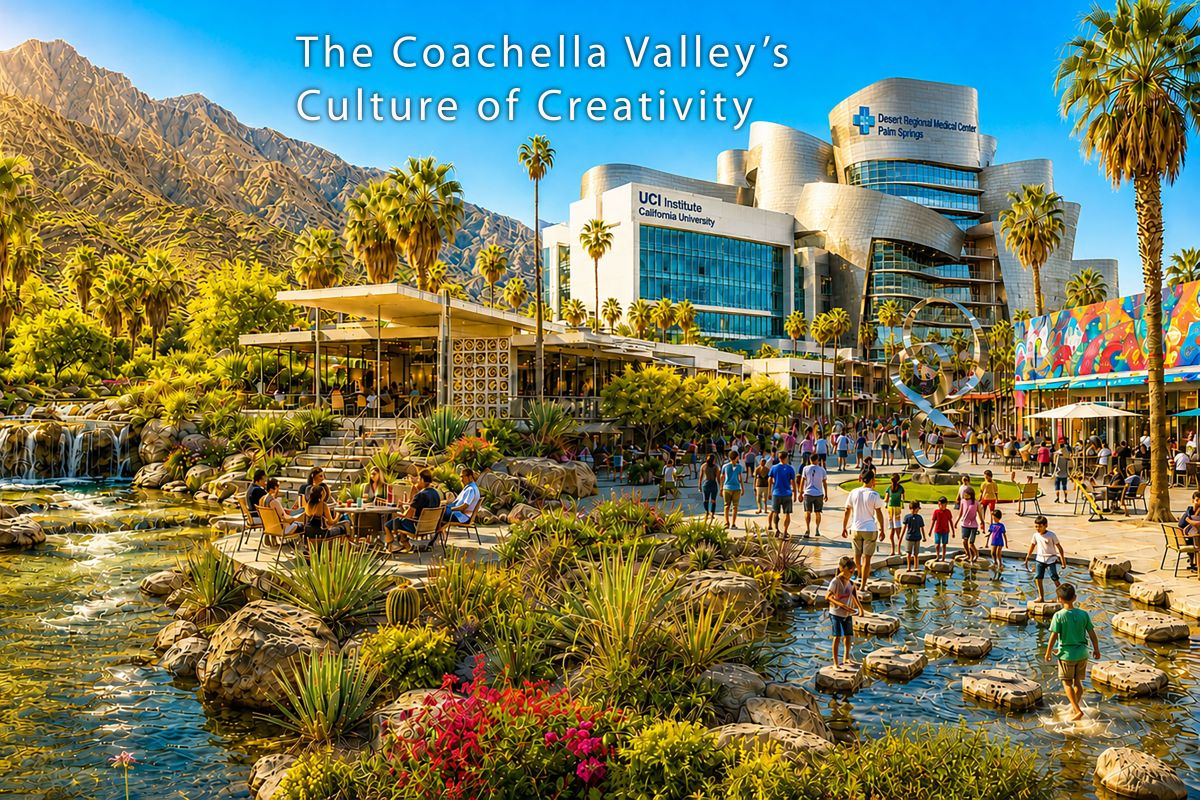
By Marty Treinen & Wesley Spencer
© 7-1–2026
Why We Came Here
We moved to the Coachella Valley for a reason.
Like so many people, we had come here before. Each time, we felt something that is not always easy to find. We felt welcomed. We felt safe. We felt a sense of openness. People were friendly. People were kind. There was a feeling that we could become part of a community, not just live next to one.
That matters.
Across the country, too many places are beginning to feel the same. The same buildings. The same stores. The same developments. The same loss of local identity. In many communities, the arts have declined, public life has weakened, and people can live for years without ever really feeling connected to the place around them.
For us, the Coachella Valley felt different.
It felt like a place people came to breathe again. A place people came to escape the sameness, pressure, noise, and isolation that so many of us have felt elsewhere. A place where people could feel safe, create, connect, gather, and find others who were also looking for something more human.
In many ways, is that not part of what this region has always offered?
A place to arrive. A place to restore. A place to imagine. A place to build a life with more beauty, more freedom, more community, and more room to become yourself.
That is why we came.
We came because we wanted to be part of a culture of creativity.
And once you see the Coachella Valley through that lens, it becomes clear that creativity is not just something added to this region. It is one of the reasons people remember it, return to it, invest in it, and call it home.
What Makes This Place Memorable?
What would the Coachella Valley be without the things that make people feel connected to it?
Take away the architecture. Take away the design. Take away the restaurants with atmosphere and the hotels that feel like destinations. Take away the galleries, museums, theaters, film, music, festivals, public art, fashion, nightlife, LGBTQ+ culture, midcentury modernism, cultural heritage, and the desert style people recognize around the world.
There would still be weather. There would still be buildings. There would still be streets. There would still be real estate.
But would people feel the same pull to visit, return, invest, open a business, bring friends, or say, “You have to experience this place”?
That is the question we need to ask.
We Can Still Choose What Comes Next
Unlike many places around the world, the people of the Coachella Valley can still choose what this region becomes.
That is not a small thing.
We are not locked into one future. We are not limited to being only a visitor economy, only a retirement economy, only a service economy, or only a place people pass through for a season and then leave behind. We have something deeper already here. We have the foundation of a culture of creativity.
That is the difference.
Across Palm Springs, Cathedral City, Desert Hot Springs, Rancho Mirage, Palm Desert, Indian Wells, La Quinta, Indio, Coachella, and every community in this Valley, creativity is already shaping how people live, work, gather, build, remember, and imagine what comes next.
It is in our architecture, our restaurants, our hotels, our theaters, our museums, our galleries, our music, our festivals, our small businesses, our classrooms, our public events, our personal studios, our cultural heritage, and the people who keep finding ways to make ideas real.
This is a practical conversation about the future of the Valley.
It is about the businesses we want to grow, the students we want to prepare, the communities we want to strengthen, the visitors we want to welcome, the residents we want to serve, and the future we still have the ability to shape.
Why a Culture of Creativity Matters
What if a culture of creativity in the Coachella Valley is one of the main reasons this region works?
What if it is also one of the best foundations we have for what comes next?
By a culture of creativity, we mean the creative people, designers, writers, performers, musicians, architects, filmmakers, chefs, photographers, educators, museums, theaters, galleries, festivals, studios, restaurants, hotels, public events, cultural heritage, and creative businesses that help make this place recognizable, memorable, and alive.
That culture of creativity affects all of us, whether we work in a creative profession or not.
It affects the restaurant owner who needs people walking through the door. It affects the hotel that needs visitors to choose this destination over another. It affects the small business that needs to be seen, trusted, and remembered. It affects the worker whose job depends on tourism, hospitality, events, food, retail, entertainment, or local services. It affects the resident who wants a community that feels alive. It affects the student who needs to learn how to imagine, communicate, create, and adapt.
It affects the real value of the place we live.
Experience Is What People Remember
People do not come to Palm Springs or the Coachella Valley only for warm weather. Weather may open the door, but experience is what makes people remember. The experience of this region has been created over time by architects, creative people, designers, performers, writers, chefs, musicians, hoteliers, photographers, preservationists, museum professionals, theater professionals, educators, event producers, business owners, and community members.
Together, they have helped shape a place people can recognize, desire, and share with others.
That is economic value.
A visitor may come for a festival, then stay in a hotel, eat in restaurants, shop downtown, visit a museum, take photographs, attend a performance, and return the next year with friends. A resident may attend a local theater, then go to dinner, invite guests, support a small business, and feel more connected to the community. A conference guest may come for a meeting, but what they remember is the place: the light, the architecture, the food, the room, the hospitality, the public life, and the feeling of being here.
That is the creative multiplier.
Creative culture creates reasons for people to gather. Gathering creates activity. Activity supports businesses. Businesses support jobs. Jobs support families. Families support communities. Communities create identity. Identity attracts more participation.
That is economic motion.
Beyond Tourism
This does not mean the future of Palm Springs or the Coachella Valley should depend on tourism alone. In fact, the opposite is true. If we want a stronger and more resilient regional economy, we can use creative culture as a bridge into business development, entrepreneurship, education, workforce training, product creation, and community-based economic growth.
The same creative capacity that helps attract visitors can also help local businesses grow, help entrepreneurs bring ideas to life, help students prepare for the future, and help communities create value from within. Tourism may be one powerful expression of the Valley’s creative identity, but it should not be the only one.
Every Business Depends on Creative Work
Every business in the Valley depends on creative work in some way. A restaurant needs more than food. It needs a menu, a room, lighting, music, service, photography, social media, signage, and a feeling people want to repeat. A hotel needs more than beds. It needs architecture, interiors, branding, hospitality, atmosphere, story, and memory. A nonprofit needs more than a mission. It needs language, trust, fundraising, events, visuals, and public connection. A city needs more than infrastructure. It needs identity.
Even businesses that do not think of themselves as creative businesses still depend on creative people. They need websites, logos, photographs, videos, advertising, writing, design, presentations, events, packaging, interiors, customer experience, and public communication. They need people to understand what they offer, why it matters, and why they should choose them.
A business survives when people understand, trust, remember, and desire what it offers.
That is why creative people are part of how businesses and communities become visible, memorable, and trusted.
They help products become understandable. They help places become memorable. They help organizations build trust. They help communities tell their own stories.
Before Anything Can Be Sold, It Must Be Created
This goes deeper than marketing or promotion.
Every business begins with a product, service, or experience. Someone has to imagine it, shape it, test it, refine it, produce it, deliver it, and improve it. A product does not appear in the world by accident. A hotel experience does not happen by accident. A restaurant does not become memorable by accident. A museum exhibition, a theater season, a conference, a public event, a wellness retreat, or a classroom experience must be created.
Before anything can be sold, someone has to create the thing being offered.
That is why creativity is one of the ways human beings make value real.
The creative process teaches people how to take an idea and bring it into form. That form may be a painting, building, performance, product, meal, film, song, website, exhibition, classroom, business, or public event. The form may change, but the process remains: observe, imagine, test, revise, collaborate, communicate, and improve.
Those are life skills. Business skills. Community skills. Leadership skills.
Creative People Carry the Process With Them
This is why creative education and creative practice matter so much. Creative people do not appear out of nowhere. They are developed in classrooms, studios, rehearsal rooms, music rooms, shops, theaters, museums, design programs, personal workspaces, community programs, and through years of practice. Some work in traditional creative fields. Many move into business, hospitality, education, tourism, nonprofit work, design, media, communications, product development, and entrepreneurship.
They carry the creative process with them.
That is one of the most overlooked parts of the economy. People trained in creative fields often support two economies at once. They support the visible arts-and-culture economy, and they support the wider business economy that depends on creative labor but often calls it something else.
We may call it marketing. We may call it branding. We may call it product development. We may call it customer experience. We may call it tourism. We may call it hospitality. We may call it communication. We may call it design. But underneath those names is creative culture at work.
This is why creative work is so often undercounted.
We Have to Look at the Whole System
We count the museum, but may miss the designer working from home. We count the theater, but may miss the performer producing business events. We count the festival, but may miss the photographers, writers, videographers, technicians, musicians, stage crews, printers, social media creators, and hospitality workers who help make the experience possible. We count tourism, but may not fully count the creative culture that gives tourists a reason to come in the first place.
If we want to understand the true value of creative culture in the Coachella Valley, we have to look beyond the obvious categories.
We have to look at the whole system.
The galleries. The theaters. The museums. The festivals. The restaurants. The hotels. The architecture. The designers. The public art. The schools. The studios. The writers. The photographers. The performers. The musicians. The filmmakers. The educators. The shops. The event producers. The creative small businesses. The people working quietly in personal studios, garages, music rooms, computer stations, and rehearsal spaces before the public ever sees the work.
That is creative infrastructure.
When we support it, we strengthen one of the things that makes this region valuable.
Building a More Sustainable Creative Future
This is the part we need to think about carefully. Communities often recognize creative culture after it has already created value. Creative people, designers, performers, writers, musicians, and small creative businesses help make a place distinctive and alive. Then the place becomes desirable. Then the value rises. The next step must be making sure the people and spaces that helped create that value remain part of the future.
That is how we build a more sustainable creative economy.
If creative culture helps create the identity and economy of a place, then creative people should be included in the future of that place. They should be part of education, business development, community planning, tourism, public events, and economic strategy. Not as charity. Not as decoration. As part of the foundation.
Because the benefit is shared.
When a culture of creativity is strong, local businesses have more reasons to connect with customers. Visitors have more reasons to come. Residents have more reasons to gather. Students have more ways to develop imagination and confidence. Communities have more ways to tell their stories. Cities have stronger identities. The economy has more movement.
And people have more ways to belong.
Creativity Belongs to Everyone
That may be the most important part.
Creative culture helps a community become more than a marketplace. It helps it become a shared human experience. It gives us moments where we see one another, listen to one another, remember together, celebrate together, and imagine something larger than ourselves.
But there is one more important truth.
Creativity does not belong only to people who work in creative professions.
Every person has creative capacity. It may show up in how someone solves a problem, starts a business, prepares a meal, teaches a child, designs a room, repairs something broken, writes a message, organizes a gathering, leads a team, cares for a neighbor, or imagines a better future for their family.
The question is not whether people have creativity.
The question is whether they have been given the opportunity, encouragement, tools, and process to unlock it.
We unlock creativity by giving people a process, a place, a purpose, and permission to begin. We unlock it through education, mentorship, collaboration, practice, community spaces, and real opportunities to make ideas visible. We unlock it by helping people understand that creativity is not a rare gift for a few, but a human capacity that can be developed across a lifetime.
That is why a culture of creativity matters to every community in the Coachella Valley.
It does not only support the creative people we already recognize. It helps residents, students, workers, entrepreneurs, business owners, educators, and community leaders discover what they are capable of creating next.
What We Choose Now
We came to the Coachella Valley because this place felt different.
We felt welcomed. We felt a sense of openness. We felt that people could come here to breathe, create, connect, and become part of something larger than themselves.
That is not something to take for granted.
If this Valley has given so many people a place to restore, imagine, gather, and belong, then we have a responsibility to understand what made that possible in the first place.
It was not only the weather. It was not only the buildings. It was not only the real estate.
It was the culture of creativity.
It was the people, places, businesses, events, classrooms, stages, studios, restaurants, hotels, museums, public spaces, and community traditions that helped make this region feel alive.
That is why this conversation matters.
Every one of us benefits when the place we live has meaning, energy, memory, beauty, opportunity, and life. Every community benefits when people have more ways to gather, more ways to participate, more ways to create, and more ways to belong.
So the question is not simply whether we value creativity.
The question is whether we will build from it.
The opportunity now is to use that culture of creativity with intention. It can help strengthen local businesses, prepare students, support workers and entrepreneurs, connect residents, and give every city in the Coachella Valley more ways to shape a future that is distinctive, connected, and human.
That is the opportunity in front of us.
Without a culture of creativity, Palm Springs and every community across the Coachella Valley would not simply lose art. We would lose part of what makes this region recognizable, welcoming, resilient, and alive.
But if we choose to recognize, support, and build from the culture of creativity already here, we give every community in the Coachella Valley a stronger chance to shape what comes next.
That is why we came here.
And that is why we believe the future of this Valley can be created together.
About the Authors
Marty Treinen and Dr. D. Wesley Spencer are the co-developers of Universal Creative Intelligence and Universal Leadership Education. Together, they bring decades of experience across the arts, education, communication, business, creativity, leadership, and large-scale international project environments, including work connected to multi-billion-dollar resorts, casinos, hospitality, design, fabrication, and construction-related projects in the United States and Asia. Spencer teaches communication at the College of the Desert. He holds a Ph.D. in theater and communication and has spent more than 25 years as a college educator, director, actor, writer, and organizational leader.
They are also the authors of “Universal Creative Intelligence: How the Arts and Sciences Propel Human Advancement”. From that foundation, they developed Universal Leadership Education, based on Universal Creative Intelligence.
2026 © Marty Treinen & Wesley Spencer All Rights Reserved
AI Assisted Graphics: Marty Treinen © All Rights Reserved
Contact Marty Treinen service.to.others.cci@gmail.com